

Seventy-two hours in Washington DC is enough time to experience the capital's defining landmarks without turning the trip into a race. The most efficient plan assigns one day to the National Mall, one to Capitol Hill and Penn Quarter, and one to neighborhoods and art. This keeps daily transfers manageable while leaving room for museum visits, meals and the occasional bench break.
- Day 1: Explore the National Mall, choose one or two Smithsonian museums, and finish among the memorials.
- Day 2: Visit Eastern Market, the Capitol area, the Library of Congress, Penn Quarter and the National Portrait Gallery.
- Day 3: Choose Georgetown and Dupont Circle, an art-focused day, or a blend of both.
- Use Metro to reach each main sightseeing zone instead of searching for parking near major landmarks.
- Reserve a Washington Monument time if the observation level is a priority.
- Check museum schedules, tour availability and National Park Service alerts shortly before the trip.
This itinerary favors geographic clusters over a long checklist. That choice matters on the National Mall, where the open sightlines can make destinations look closer than they are. Our National Mall guide for first timers is a useful companion for choosing memorials and understanding the broader layout before arrival.

Hop-on Hop-off Tour of DC with 18 Stops and Arlington Audio Tour
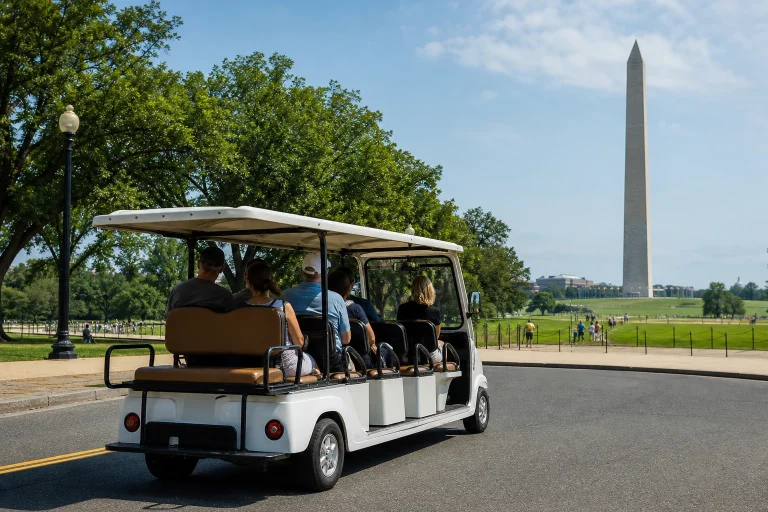
Explore Washington, D.C. with the Official Tour of the National Mall. As the National Park Service's authorized concessionaire, Big Bus takes you clos...
Washington DC in 72 hours at a glance
| Day | Primary area | Main plan | Flexible finish |
|---|---|---|---|
| Day 1 | National Mall | Smithsonian museums, Washington Monument area and memorials | A night monument walk or tour |
| Day 2 | Capitol Hill and Penn Quarter | Eastern Market, Capitol area, Library of Congress and National Portrait Gallery | Dinner near Capitol Hill or Penn Quarter |
| Day 3 | Georgetown, Dupont Circle or central art museums | Neighborhood exploration, art and a slower final afternoon | Return to a favorite area or depart |
The order can be reversed to match reservations or changing schedules. Preserve the geographic groupings even when moving the days around. Pair the Mall with its museums and memorials, keep Capitol Hill together, and save the final day for the interests that did not fit neatly into the first two.
Set up the trip before the first morning
Choose a convenient base
A central hotel can simplify a short visit because each day begins in a different sightseeing district. Compare the best Washington DC hotels near the National Mall if monument and museum access is the top priority. A different central neighborhood can work equally well when it offers a straightforward Metro trip to the day's first stop.
Plan around Metro rather than parking
Metro is the practical backbone of this route. Smithsonian and Federal Triangle are recommended access points for the National Mall, while public transportation is encouraged around the Washington Monument because nearby parking is limited and often fills. Review how to get around Washington DC without a car before the trip, then check current transit service and fares directly before traveling.
Book the Washington Monument first
The Washington Monument observation level requires timed entry. Advance tickets are generally released 30 days ahead, while same-day tickets are distributed beginning at 8:45 a.m. Visitors should reach security screening at least 15 minutes before entry. The posted 2026 schedule is 9 a.m. to 5 p.m., with one maintenance closure each month, so confirm the current calendar before reserving.
Use a Washington Monument tickets and visitor guide to understand the reservation process, but avoid building the entire day around an unconfirmed time. Museum schedules, Capitol tours and special programming can vary. Once the fixed reservation is secured, arrange the flexible stops around it.
Leave room for changing access
Events, security measures, weather and maintenance can temporarily change access around the National Mall. Check National Park Service alerts shortly before Day 1 rather than relying on an older closure notice. A flexible museum order makes it easier to adjust without losing an entire morning.
Day 1: National Mall museums and memorials
Morning: Enter the Mall and choose one major museum
Take Metro to Smithsonian or Federal Triangle and begin with one museum that matches your strongest interest. Give it a meaningful block of time rather than attempting to rush through several large collections. If a second museum is important, place it nearby and treat everything else as optional.
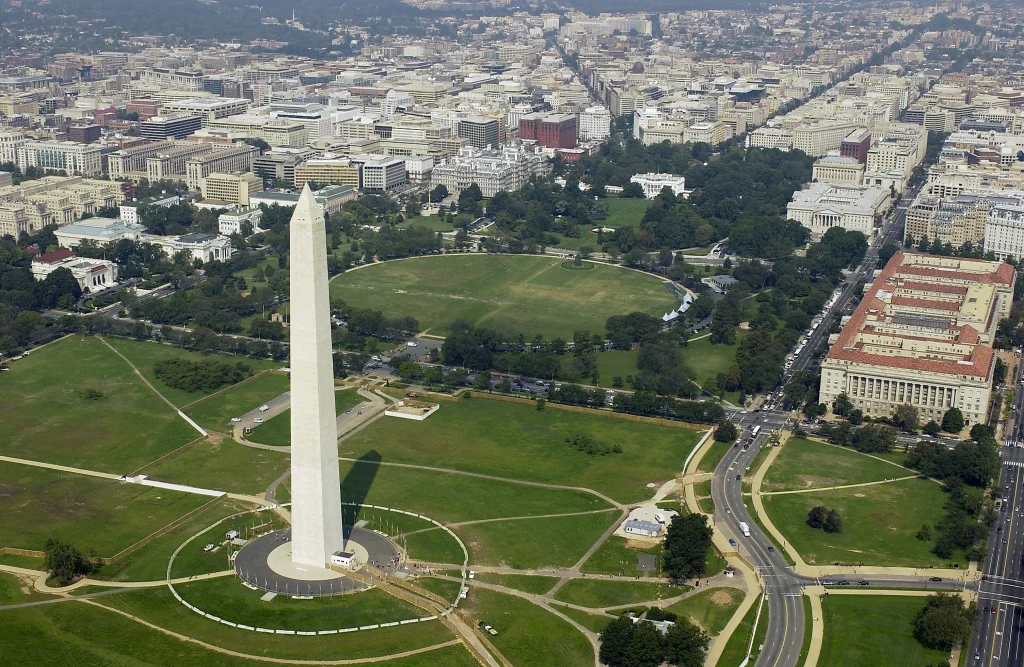
This is also the best place to protect the schedule from museum fatigue. Step outside between visits, drink water and pause before deciding whether to enter another building. Indoor time and rest breaks are especially useful for travelers managing limited stamina across a full Mall day.
Midday: Fit in the Washington Monument
Place a confirmed Washington Monument entry between museum blocks or before the memorial portion of the day. The elevator reaches the observation level and is accessible to wheelchair users. Nearby accessible restrooms are available, but accessible parking is limited, reinforcing the value of arriving by public transportation.
Without a ticket, keep the monument as an exterior stop and use the saved time for a longer museum visit. The Mall itself and most of its sites do not charge an entrance fee, so the day can remain flexible even when a timed reservation is unavailable.

DC Monuments by Night: 10+ Landmarks | Open-Top Upgrade Available
See a different side of Washington DC after dark on a guided night tour of the city's floodlit monuments. This tour...

Washington DC Monuments by Moonlight Tour by Trolley
You haven't seen Washington DC until you've seen it at night! On this evening 100% live narrated tour, you'll enjoy...
DC Monuments Night Tour with 10+ Stops, National Mall, Tickets
Experience Washington DC lit up at night during this 3-Hour Guided Night Tour of the National Mall and Monuments. Ma...
Afternoon: Follow a manageable memorial route
Devote the afternoon to a compact group of memorials instead of crossing the Mall repeatedly. Decide in advance which sites matter most, then add others only if energy and time allow. The broad landscape rewards a slower pace, but its scale can surprise visitors who judge distance by sight alone.
Travelers with limited stamina can replace a long memorial loop with the Washington Monument elevator experience or one substantial museum visit. Build in water, indoor breaks and seated rest. All major National Mall monuments and memorials are wheelchair accessible, although the amount of ground covered still deserves careful planning.
Evening: See the monuments after dark
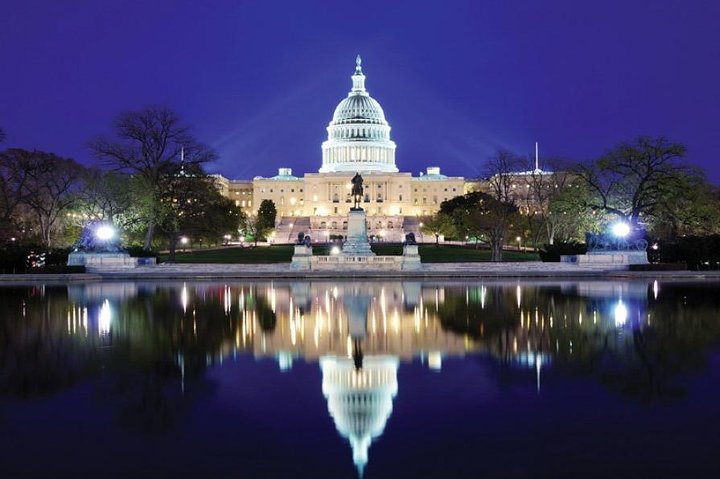
A night walk or organized tour is a logical finish because it stays within the same landmark district. Use a Washington DC monuments by night guide to decide between an independent route and a guided experience. If the afternoon was physically demanding, shorten the evening rather than sacrificing the next morning.
Day 2: Capitol Hill, Penn Quarter and portraits
Morning: Begin around Eastern Market
Start Day 2 around Eastern Market, then move toward the Capitol complex. This sequence introduces a neighborhood setting before the formal landmarks take over the middle of the day. Check the market's operating schedule for your travel date before making it the first fixed stop.
Late morning: Keep the Capitol landmarks together
Continue to the U.S. Capitol area, the Library of Congress and the Supreme Court exterior. These stops belong in one geographic block, which avoids an unnecessary return later. A United States Capitol tour guide can help with advance planning, but tour availability should be confirmed before assigning a precise time.
If a Capitol tour is unavailable, keep the exterior and nearby institutions in the plan. The schedule remains useful because the district offers several priority stops within the same portion of the city. Do not compensate by adding a distant attraction that creates another cross-city transfer.
Afternoon: Shift to Penn Quarter and Chinatown
Move toward Penn Quarter and Chinatown for the second half of the day, then make the National Portrait Gallery the main cultural stop. This creates a clean transition away from Capitol Hill without returning to the National Mall museum cluster covered on Day 1.
Choose lunch or dinner according to the confirmed tour and museum schedule. If dining close to the morning route matters, consult a Capitol Hill restaurants guide and reserve only after the day's fixed admission times are settled. Otherwise, let Penn Quarter serve as the evening endpoint.
Day 3: Georgetown, Dupont Circle or an art-focused finale
The final day should reflect personal interests rather than repeat the landmark-heavy pace of Days 1 and 2. Official itinerary suggestions support a choice between Georgetown and Dupont Circle, central art museums such as the National Gallery of Art, or a more neighborhood-led experience.
Option A: Georgetown and Dupont Circle
Choose Georgetown and Dupont Circle when the trip needs more neighborhood time after two formal sightseeing days. A Georgetown Washington DC travel guide can help narrow the morning to the area's streets, food and shopping interests. Continue to Dupont Circle only if the pace remains comfortable, rather than treating both neighborhoods as another checklist.
Option B: Make art the priority
Choose an art-focused day if museums were the main reason for visiting Washington. Begin with the National Gallery of Art, then decide whether to add another art museum or shift into a nearby neighborhood. Keeping the second stop optional protects the final afternoon from becoming rushed.
Still comparing Washington DC 72 Hour Itinerary?
Ask for tour ideas, hotel suggestions, or a simple trip plan that combines both.
Trip Helper
Option C: Follow neighborhood art and local streets
A neighborhood-led day offers the strongest contrast with the monumental core. Use a Washington DC murals and street art guide to shape a visual theme, then leave time for an unhurried meal. This version suits travelers who already covered their essential museums and want a less formal final impression of the city.
Adjust the itinerary for mobility and energy
Do not treat the National Mall as one short walk. Arrive and depart by Metro, group neighboring sites, and decide which long outdoor segment can be removed if energy drops. Replacing part of a memorial loop with one museum or the Washington Monument elevator keeps the day substantial without demanding constant movement.
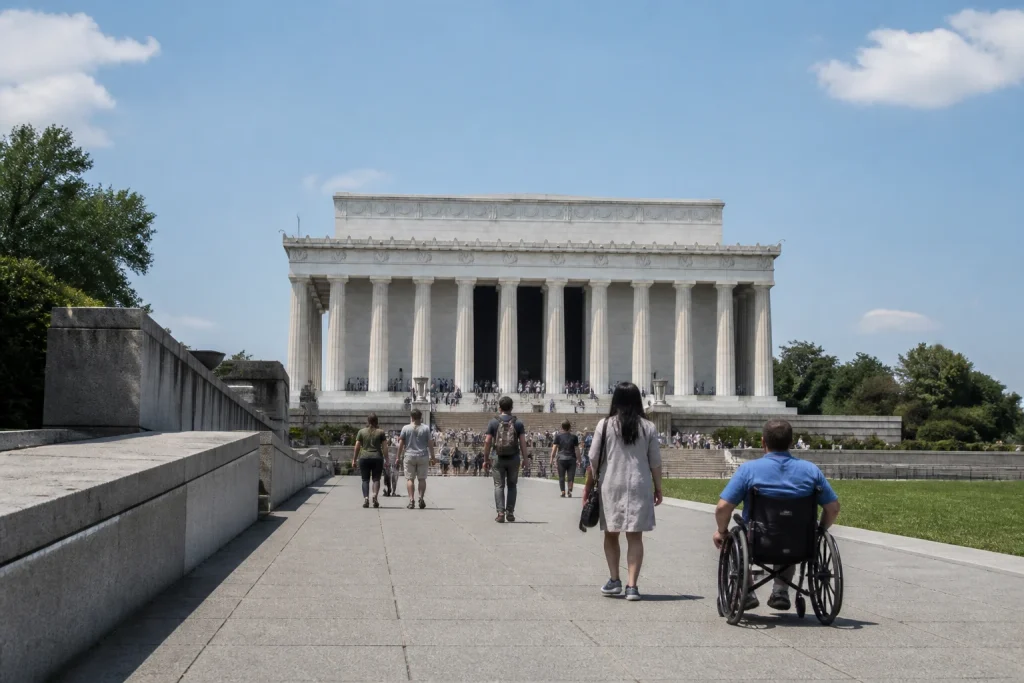
All major National Mall monuments and memorials are wheelchair accessible. Access aids include free braille brochures at several memorials, large-print material at the Lincoln Memorial and closed captioning for films at the Lincoln, Jefferson and Washington Monument locations. No-charge ASL interpretation can be requested at least three weeks ahead.
The Washington Monument uses an elevator to reach its observation level and accommodates wheelchair users. Service animals are permitted, and accessible restrooms are nearby. Because parking is limited, travelers using mobility equipment should still plan transportation and the approach to the monument before their timed entry.
- Limit Day 1 to one major museum and a shorter memorial route.
- Use Metro for the beginning and end of each sightseeing cluster.
- Schedule seated breaks before fatigue becomes a problem.
- Carry water and preserve indoor time during the Mall day.
- Place timed reservations between flexible stops rather than stacking fixed appointments.
Budget for reservations, transportation and optional extras
There is no entrance fee for National Mall and Memorial Parks or most of its sites. The National Park Service identifies the Washington Monument and Ford's Theatre National Historic Site as locations requiring timed-entry tickets. Ticket procedures can change, so review the current booking flow without assuming a specific service fee.
| Expense | Planning approach |
|---|---|
| National Mall access | No entrance fee for the park or most sites |
| Timed entry | Reserve priority sites and confirm the current booking terms |
| Transportation | Check current Metro fares and service before travel |
| Parking | Avoid depending on limited parking near the Washington Monument |
| Optional experiences | Budget separately for guided tours, meals and other booked activities |
The itinerary can emphasize low-cost public spaces while leaving room for selected paid experiences. Spend where convenience matters most, such as a well-located hotel or an evening monument tour, rather than adding several reservations that compete for the same limited hours.
Adapt the plan to arrival and departure times
For an evening arrival, check in and save the main attractions for the first full morning. A short neighborhood meal or a carefully limited monument walk is enough. Starting Day 1 tired creates problems later because the Mall requires more movement than its open layout initially suggests.
For an early departure on Day 3, keep the final morning in one neighborhood or choose a single art museum. Do not place an essential timed reservation close to the departure window. Georgetown, Dupont Circle and an art-centered plan are alternatives, so losing one option does not unravel the first two days.
Travelers with an extra night can slow the Mall day or move one neighborhood to a fourth morning. A 4 days in Washington DC itinerary is the better framework when several large museums, additional neighborhoods or a day trip are nonnegotiable.

VIP Best of DC with US Capitol + National Archives Reserved Entry
Get the presidential treatment with the most comprehensive Washington DC day tour! The tour includes reserved access...

Smithsonian "Big 3" Highlights Tour (Air & Space Entry Included)
See the best of the Smithsonian Museums on a 3-hour guided tour of the highlights of the American History, Natural H...

US Capitol with Library of Congress or Supreme Court Entry
Join an expert local guide on this small-group guided tour of Capitol Hill, one of the top things to do in DC! Expl...
Make three days feel complete, not crowded
This Washington DC 72-hour itinerary works best for first-time visitors who want the landmark core plus one broader look at the city. Its main limitation is choice: no three-day plan can give every museum, memorial and neighborhood the time it deserves. Reserve the Washington Monument if it matters, confirm daily schedules, and keep at least one optional stop on each day.
The payoff comes from the sequence. The Mall establishes Washington's monumental scale, Capitol Hill adds the civic landmarks, and the final day introduces art or neighborhood life. Follow that rhythm, protect time for rest, and the trip will feel deliberate rather than compressed.
Frequently asked questions
Is 72 hours enough for Washington DC?
Yes, 72 hours is enough for the National Mall, Capitol Hill and one neighborhood or art-focused day. It is not enough to explore every museum, so choose a few priorities and group them geographically.
Do I need a car for this Washington DC itinerary?
No, this itinerary is designed around Metro and walking. Smithsonian and Federal Triangle are useful National Mall access points, and public transportation is recommended near the Washington Monument because parking is limited.
How much walking should I expect in three days?
Expect substantial walking, especially on the National Mall. Avoid treating the Mall as one short route, use Metro for arrival and departure, and replace a long memorial loop with one museum or the Washington Monument elevator if stamina is limited.
Which Washington DC attractions need advance reservations?
The Washington Monument observation level requires timed entry. Advance tickets are generally released 30 days ahead, and same-day distribution begins at 8:45 a.m.; confirm the current process before booking. Check Capitol tours and museum schedules separately.
Is the National Mall free to visit?
Yes, there is no entrance fee for National Mall and Memorial Parks or most of its sites. Timed tickets are required at the Washington Monument and Ford's Theatre National Historic Site, while transportation and parking can add costs.
Is the National Mall wheelchair accessible?
Yes, all major National Mall monuments and memorials are wheelchair accessible. The Washington Monument elevator also accommodates wheelchair users, and several memorials provide braille, large-print, captioning or advance-request interpretation services.
What should I do if part of the National Mall is closed?
Check current National Park Service alerts and adjust the order of museums and memorials. Temporary restrictions can result from events, security measures, weather or maintenance, so keep at least one indoor stop flexible.
Hop-on Hop-off Tour of DC with 18 Stops and Arlington Audio Tour
Explore Washington, D.C. with the Official Tour of the National Mall. As the National Park Service's authorized concessionaire, Big Bus takes you clos...
Experiences to explore
 Explore experience ↗
Skip the Line National Archives and Capitol Hill Tour
◷ 2 hr 30 min
Visit the National Archives and Capitol Hill without the long lines. This tour grants you skip-the-line access to the Declaration of In
From $99.00 USD
View dates Explore experience ↗
Capitol Hill with US Capitol, National Mall Bus Tour, Boat Cruise
◷ 8 hr
Explore Washington DC on this Full Day Guided Bus, Walking, and Boat Tour. Start your day with a 2-hour Guided Walking Tour through Cap
See dates for Current pricing
View dates Explore experience ↗
Private Dupont Circle Walking: Personalized Self-Guided App Tour
◷ 1 hr–2 hr
Escape to the vibrant streets of Dupont Circle in Washington D.C. Dupont Circle is a fun and vibrant place in Northwestern D.C. Come se
See dates for Current pricing
View dates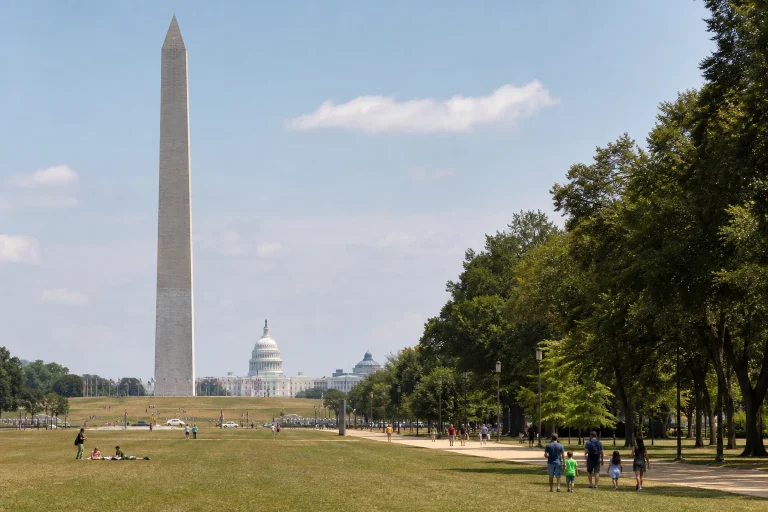

2 Comments
[…] pairs Dupont Circle with a rooftop bar. Willard InterContinental offers historic grandeur near the National Mall, while YOTEL Washington DC provides a sleek Capitol Hill base. These are distinct experiences […]
[…] tickets are required for the Washington Monument observation level. Advance tickets are typically released 30 days ahead, while same-day tickets begin at 8:45 a.m. […]