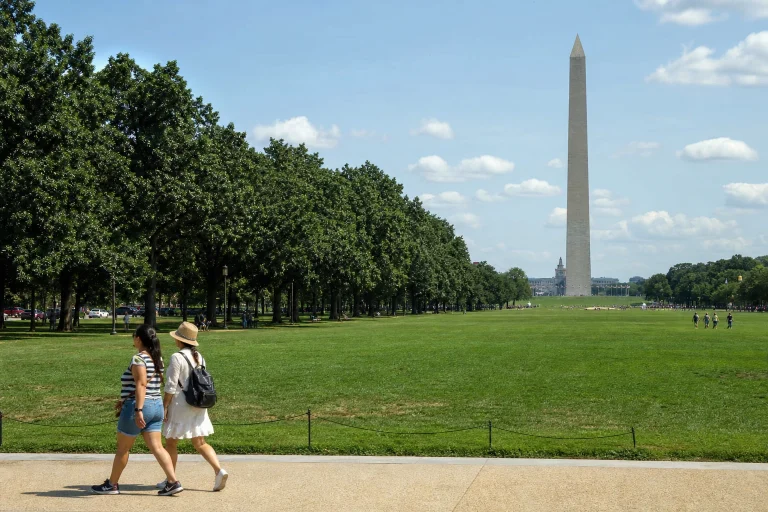
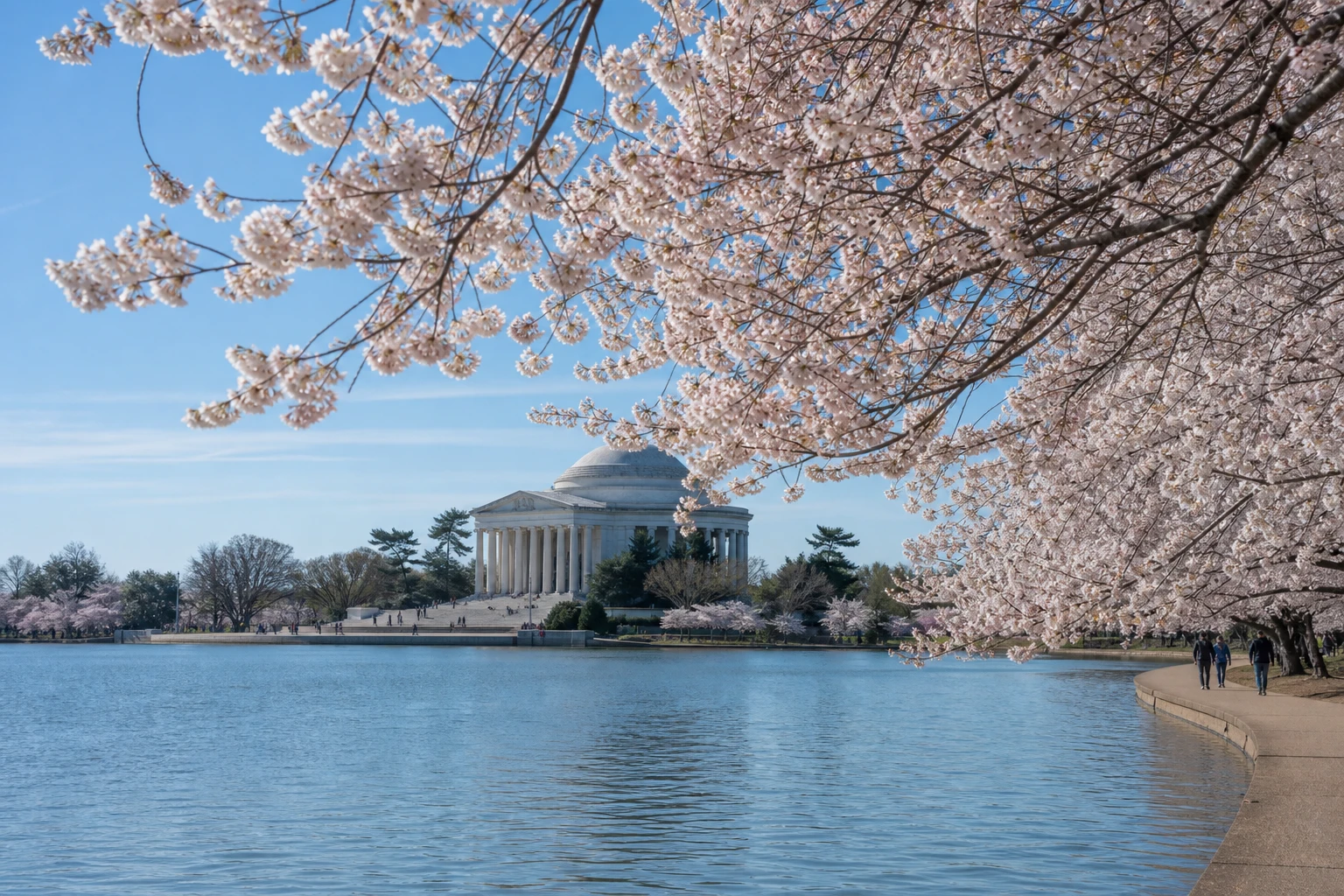
Washington DC’s cherry blossoms are worth planning around, but the Tidal Basin is not a secret spring corner. More than 1.5 million visitors come during the National Cherry Blossom Festival, so the practical goal is not solitude. It is a visit with fewer avoidable bottlenecks: flexible bloom timing, a smarter Metro approach, enough walking time, and a current plan for conditions on the ground.
- Do not lock a 2027 trip to a predicted peak-bloom weekend. Bloom timing can shift quickly with the weather.
- Use the NPS Bloom Watch close to departure, rather than relying on a long-range forecast.
- Ride Metro, but choose an approach that does not funnel you through Smithsonian station.
- Expect a meaningful walk. The documented Tidal Basin loop is 1.8 miles, before any walk from a station.
- Treat driving, parking, detours, and accessible routing as trip-specific details to confirm shortly before visiting.
Start with a realistic crowd strategy
The most useful crowd strategy changes how you define success. Plan to see the blossoms and the Tidal Basin without adding a long parking search, an unnecessarily congested station approach, or a tightly timed schedule that unravels when bloom dates move. Peak bloom and a lightly attended Basin do not reliably go together, especially during the festival.

Washington DC: Cherry Blossoms by Bike Tour
Experience the beauty of Washington DC in its spring glory on this 2-hour bike tour created specifically for the famous National Cherry Blossom Festiv...

DC Cherry Blossoms Insiders Tour
Discover the beauty and significance of Washington DC's cherry blossoms on this insightful 2.5-hour walking tour led...

Cherry Blossoms at Dawn Private Washington DC Sunrise Tour
Experience Washington’s cherry blossoms in the quieter early-morning hours, before the Tidal Basin reaches its hea...

The DC Cherry Blossom Bus Tour with Tidal Basin Guided Walk
Enjoy the fragrant, fluffy blooms of the famous Washington cherry blossom with this short springtime tour, which inc...
A less pressured visit comes from choices that spread out your arrival and leave room to adapt. Use transit rather than a car, accept that an alternate station means extra steps, and avoid treating a forecast as a reservation. Those tradeoffs create a more manageable day even when the city is at its busiest.
Plan around bloom conditions, not a fixed 2027 weekend
NPS identifies the last week of March through the first week of April as the most likely peak-bloom period. The actual date has ranged from March 15 to April 18 because weather drives the trees’ progress. A 2027 peak-bloom date is not set this far ahead, and NPS horticulturists caution that forecasting is nearly impossible more than 10 days in advance.
The 2026 season shows why flexibility matters. NPS initially forecast peak bloom for March 29 through April 1, then recorded actual peak bloom on March 26. The lesson is simple: make the official Bloom Watch part of your final planning, especially if the blossoms are the main reason for your trip.
- Choose travel dates with as much flexibility as your plans allow.
- Check the NPS Bloom Watch during the final stretch before departure, rather than treating an early forecast as final.
- Review current park notices and Metro service information before setting a detailed day plan.
- Keep the Tidal Basin as the centerpiece of the day instead of packing the surrounding hours with hard-to-change commitments.
Use alternate Metro approaches to avoid the biggest arrival funnel
NPS has advised visitors to walk in from Foggy Bottom, L’Enfant Plaza, or Arlington Cemetery stations instead of using Smithsonian station, where cherry blossom crowds concentrate. This does not make the Tidal Basin uncrowded. It gives you a way to avoid adding your own arrival to the most obvious transit funnel and makes the walk into the Basin part of the outing.
| Arrival approach | Useful planning advantage | Tradeoff to accept |
|---|---|---|
| Smithsonian station | NPS places it about 0.5 mile from the Tidal Basin Welcome Area. | It is associated with the heaviest cherry blossom station crowds. |
| Foggy Bottom, L’Enfant Plaza, or Arlington Cemetery | NPS has suggested walking in from these stations to avoid the Smithsonian approach. | These approaches generally involve more walking and should be checked against current access conditions. |
| Driving to the area | None for a low-stress blossom day. | NPS warns of severe congestion, extremely scarce parking, traffic changes, temporary one-way roads, and closures during the festival. |
For a closer look at the landmark itself, a Tidal Basin Washington DC Guide is a useful companion when choosing which part of the waterfront to prioritize. Here, the central planning point is more direct: select one current transit approach, allow time for the walk, and do not expect a short stroll from the station to solve every crowd issue.
Give the Tidal Basin walk the time it deserves
NPS lists the Tidal Basin loop at 1.8 miles. That is the baseline distance to build into the day before adding the walk from Metro, a route adjustment, or a pause to take in the blossoms. An alternate-station strategy is best for visitors comfortable with additional walking, not for anyone trying to make the Basin a quick stop between tightly scheduled activities.
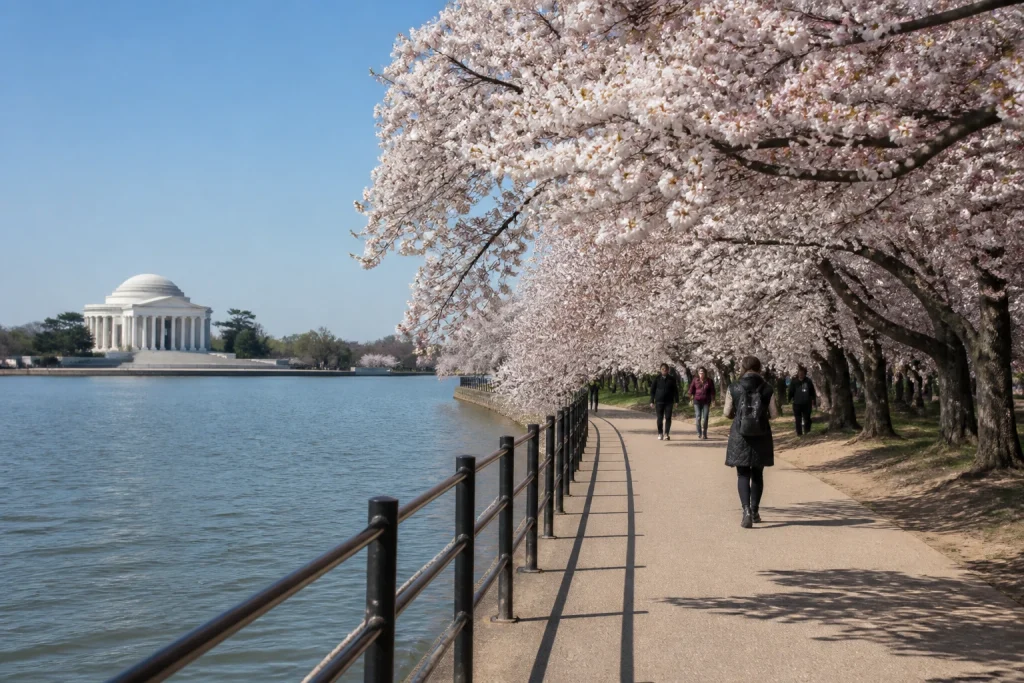
Wear footwear suited to sustained walking and carry the personal weather or mobility gear you need for an outdoor route. A sensible pace is more valuable than chasing every viewpoint. If the route changes because of active work or crowd management, a flexible schedule lets you adjust without turning a beautiful spring visit into a race.

DC in Spring: Cherry Blossom & Tidal Basin Memorials Walking Tour
This guided walking tour explores Washington, DC’s cherry blossom history while visiting some of the most meaningf...

Washington D.C. Cherry Blossom Day Tour from New York
Travel from New York to Washington D.C. for a seasonal day trip centered on the city's spring cherry blossoms. Visit...

Private Guided Tidal Basin Walking Tour in DC
Discover the rich history and beauty of Washington, DC with the Tidal Basin Walking Tour. This self-guided audio exp...
Take Metro, but check current service before you go
Public transportation is the better logistical choice for most cherry blossom visitors. Metro describes cherry blossom season as one of its busiest periods, so a train ride is not a guarantee of empty platforms. In 2026, WMATA prepared with extra trains, additional buses as needed, and added staff and police at key stations. Service plans for 2027 will be announced separately.
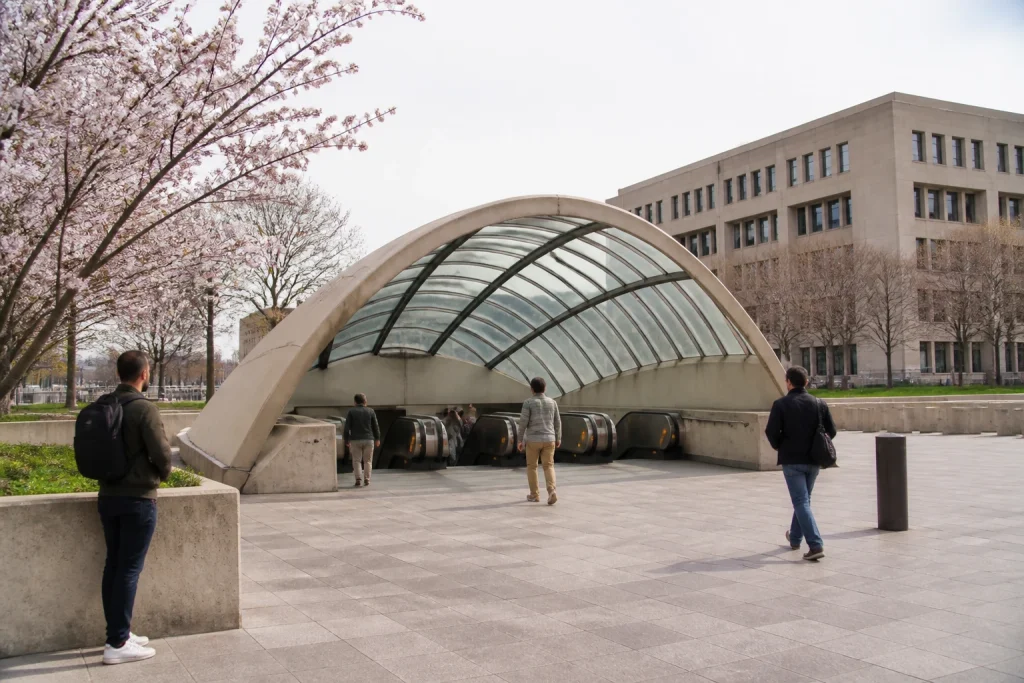
Use current WMATA notices to choose your station, service plan, and fare option for the dates you travel. Do not budget from an old festival pass or shuttle price. A practical guide to How to Get Around Washington DC Without a Car can help you connect the blossom outing to the rest of a car-free city stay.
Driving works against the low-stress goal. NPS warns that the festival period brings severe congestion, scarce parking, altered traffic patterns, temporary one-way roads, and closures. Choosing Metro also frees you from having to retrace your entire outing to a parked car after a 1.8-mile Basin loop.
Build a flexible day instead of chasing a perfect moment
The strongest plan has a clear anchor and plenty of breathing room. Make the blossoms and the Basin your main outdoor commitment, then decide on the rest of the day after you have seen current conditions. This protects the visit from a forecast shift, a service change, a detour, or simply the slower pace that comes with a major seasonal event.
- Check the Bloom Watch close to your trip and keep the exact blossom outing adjustable.
- Choose an alternate Metro approach if the additional walking suits your group.
- Allow for the 1.8-mile Tidal Basin loop as a core part of the day.
- Use current NPS information to account for detours, closures, and route changes.
- Check WMATA’s current service and fare notices before leaving for the station.
This approach is deliberately less dramatic than hunting for a hidden path or a guaranteed empty hour. Washington’s blossoms attract enormous interest because the setting is exceptional. The better result is a visit designed around what the city can actually support during the season: transit, walking, flexible timing, and a willingness to take the day as it develops.
Check access conditions shortly before your visit
The Tidal Basin has ongoing restoration and infrastructure work in its planning context. NPS identifies circulation, accessibility, connectivity, seawall solutions, and tree preservation as active issues for the area. That makes current information especially important for any visitor who needs a specific route, minimizes walking, or plans to arrive by car.
Before leaving for the Basin, review the current Bloom Watch, NPS visitor updates, and WMATA service notices. Confirm any accessibility route, parking arrangement, road closure, or detour close to the visit date. Older directions can help you understand the shape of the area, but on-the-day conditions should guide the final route.
Who this lower-stress cherry blossom plan suits
This plan suits travelers who can keep their blossom day flexible, use Metro, and handle a substantial amount of walking. Its limitation is equally clear: it cannot turn peak bloom at the Tidal Basin into a private experience. For a smoother visit, follow Bloom Watch close to travel, arrive through a current alternate-station route when practical, and let the blossoms set the pace rather than a rigid itinerary.
Frequently asked questions
When is the best time to see Washington DC cherry blossoms in 2027?
The most likely general window is the last week of March through the first week of April, but the 2027 peak-bloom date will depend on weather. NPS notes that peak bloom has occurred from March 15 to April 18, so use the Bloom Watch close to your trip rather than booking around a fixed early forecast.
Can you see Washington DC cherry blossoms without crowds?
No, visitors should not expect the Tidal Basin to be crowd-free during peak bloom and the National Cherry Blossom Festival. More than 1.5 million visitors attend the festival, but an alternate Metro approach and a flexible schedule can reduce avoidable congestion in your own plan.
Which Metro stations are better alternatives to Smithsonian for the Tidal Basin?
NPS has suggested walking in from Foggy Bottom, L’Enfant Plaza, or Arlington Cemetery stations to avoid crowds associated with Smithsonian station. These options generally require more walking, so check current route conditions before choosing one.
Should I drive to the Tidal Basin during cherry blossom season?
Driving is a poor choice for a low-stress blossom visit because NPS warns of severe congestion, very limited parking, traffic changes, temporary one-way streets, and closures. Metro is generally the more practical option, although it is also busy during the season.
How much walking is involved at the Tidal Basin?
NPS lists the Tidal Basin loop as 1.8 miles. Smithsonian station is about 0.5 mile from the Tidal Basin Welcome Area, while alternate-station approaches add further walking.
What should I check before visiting the Tidal Basin in 2027?
Check the NPS Bloom Watch, current NPS visitor updates, and WMATA service and fare notices shortly before your visit. Current information is especially important because bloom timing, transit operations, detours, accessibility routes, and traffic arrangements can change.
Cherry Blossoms at Dawn Private Washington DC Sunrise Tour
Experience Washington’s cherry blossoms in the quieter early-morning hours, before the Tidal Basin reaches its heaviest crowds.This private tour c...
Washington DC: Cherry Blossoms by Bike Tour
Experience the beauty of Washington DC in its spring glory on this 2-hour bike tour created specifically for the fam...
DC Cherry Blossoms Insiders Tour
Discover the beauty and significance of Washington DC's cherry blossoms on this insightful 2.5-hour walking tour led...

Discover Washington: A Self-Guided Tour
Discover Washington DC's monumental grandeur and democratic ideals with your self-guided audio tour, allowing you to...
Experiences to explore
 Explore experience ↗
DC in Spring: Cherry Blossom & Tidal Basin Memorials Walking Tour
◷ 1 hr 45 min
This guided walking tour explores Washington, DC’s cherry blossom history while visiting some of the most meaningful memorials along th
From $39.00 USD
View dates Explore experience ↗
The DC Cherry Blossom Bus Tour with Tidal Basin Guided Walk
◷ 4 hr
Enjoy the fragrant, fluffy blooms of the famous Washington cherry blossom with this short springtime tour, which includes a guided walk
From $59.00 USD
View dates Explore experience ↗
DC Cherry Blossoms Insiders Tour
◷ 2 hr 30 min
Discover the beauty and significance of Washington DC's cherry blossoms on this insightful 2.5-hour walking tour led by a retired Natio
From $45.00 USD
View dates