
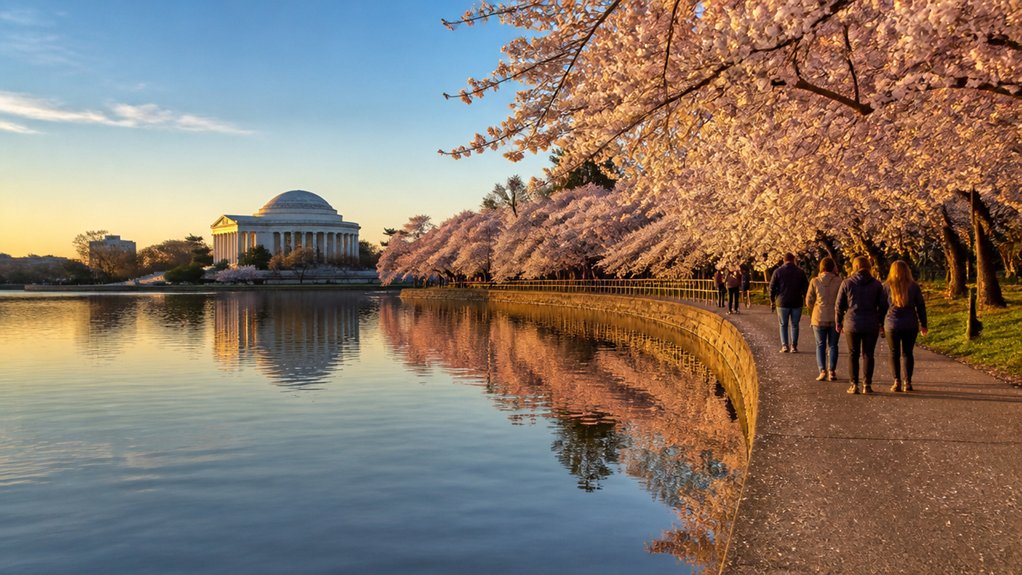
At dawn, the 1.8-mile Tidal Basin loop feels like a slow-turning postcard that suddenly starts moving. You pass the Jefferson, FDR, and MLK memorials, then catch the Japanese Lantern and stone pagoda between ripples and branches. Plan on 60 to 90 minutes, longer if you stop often or arrive in cherry blossom season when the crowds wake up early too. Start near Maine Avenue, lace up, and you’ll soon see why this short walk holds more than its map suggests.
Key Takeaways
- Walk the 1.8–2.0 mile Tidal Basin loop counterclockwise from 1501 Maine Ave SW, allowing 60–90 minutes or up to two hours with memorial stops.
- Highlights include the Jefferson, FDR, and Martin Luther King Jr. memorials, plus the Japanese Lantern, pagoda, and Washington Monument views.
- Visit from dawn to dusk year-round for free; sunrise offers cooler temperatures, softer light, and fewer crowds than later in the day.
- Cherry blossom season peaks late March to early April, bringing the best blooms, ranger walks, heavier crowds, and parking challenges.
- Bring water, snacks, sun or rain protection, and waterproof shoes; restrooms are at Jefferson, FDR, MLK, and the paddle boat kiosk.

DC Cherry Blossoms Insiders Tour
Discover the beauty and significance of Washington DC's cherry blossoms on this insightful 2.5-hour walking tour led by a retired National Mall park r...

Sunset Monuments and Memorials National Mall Walking Tour
Experience Washington, DC’s most iconic monuments at sunset. Join an expert guide along the National Mall to see t...

DC in Spring: Cherry Blossom & Tidal Basin Memorials Walking Tour
This guided walking tour explores Washington, DC’s cherry blossom history while visiting some of the most meaningf...

Architecture of Washington's National Mall Audio Guide
Uncover the meaning behind some of the most iconic structures in D.C. on this self-guided audio tour. Experience the...
Plan Your Tidal Basin Visit

If you want the classic Tidal Basin experience, start at the parking area near 1501 Maine Ave SW and walk the 1.8 to 2 mile loop counterclockwise. You won’t pay an entrance fee, and you can wander around the Tidal Basin from dawn to dusk all year. In peak cherry blossom season, usually late March through early April, expect ranger walks, festival energy, and plenty of camera clicks. The Thomas Jefferson Memorial stands on the Tidal Basin among cherry blossoms, making it one of the area’s signature views.
Bring water and a snack because there aren’t permanent restaurants here. If you want a playful break, rent a pedal boat and drift past the shoreline. Restrooms sit at the MLK Jr. bookstore, the FDR bookstore, the Jefferson Memorial, and the paddle boats kiosk. Along the way, you’ll pass grand memorials, smaller monuments, smooth water, and cherry trees that make even patient adults speed up.
Tidal Basin Loop, Route, and Timing
You can follow the Tidal Basin loop for about 2 miles, usually counterclockwise from the parking area at 1501 Maine Ave SW, with the Jefferson, FDR, and MLK Jr. memorials unfolding along the water and the Washington Monument rising in the distance. If you like an easy pace, give yourself 60 to 90 minutes, though cherry blossom season can stretch that closer to 2 hours once you start stopping for photos and views. Start at sunrise if you want softer light and fewer crowds, because late March and early April bring the prettiest petals and, yes, a lot more company. For a quieter contrast after your walk, Kenilworth Park offers a more serene escape centered on aquatic gardens.
Loop Route Details
While the Tidal Basin feels grand on a map, the classic loop is an easy, pedestrian-friendly walk of about 1.8 to 2 miles, usually done counterclockwise from the parking area near 1501 Maine Ave SW. From there, you follow the water past famous memorials without paying an entrance fee. It’s a simple route, but it never feels plain.
You’ll reach the Jefferson Memorial first, then continue toward the Franklin Delano Roosevelt Memorial and the Martin Luther King Jr. Memorial. Along the way, you catch crisp views of the Washington Monument and a few smaller monuments tucked into the landscape. Because the Tidal Basin sits within National Mall parkland, you can use the National Park Service app and wayfinding maps to stay oriented along the route. Some self-guided tours mark eight suggested stops and 19 audio points, which keeps the walk engaging. Grounds stay open from dawn to dusk year-round, though occasional maintenance can trigger short detours.
Walking Time Tips
Start with a simple rule of thumb: the Tidal Basin loop takes about 60 to 90 minutes at an easy pace for its 1.8 to 2 miles.
Use these quick timing cues as you plan your Tidal Basin walk:
- Budget 30 to 45 minutes if you’ll skip memorial detours.
- Allow 2 hours if you’re stopping at Jefferson, FDR, and MLK.
- Start at sunrise for cooler air, softer light, and fewer crowds.
- Expect slowdowns in cherry blossom season when viewpoints get packed.
- Check for flooding, closures, and open restrooms before you head out.
If you like structure, you can follow a counterclockwise audio route from parking near 1501 Maine Ave SW. It’s self-paced, with eight stops and plenty to hear. Add extra minutes for photos, paddle boat watching, and waiting. The area is part of National Mall and Memorial Parks, which includes many of Washington’s most iconic memorials and monuments.

Washington DC: Easy Sightseeing Guided Monuments Tour by E-Cart
Explore Washington, DC’s iconic monuments and memorials on a relaxed, open-air electric cart tour. Enjoy a small-g...

Washington DC's Monuments & US History Guided E-Cart Tour
This tour offers a detailed introduction to U.S. history and Washington D.C.’s famous monuments, guided by expert...

DC Monuments Night Tour with 10+ Stops, National Mall, Tickets
Experience Washington DC lit up at night during this 3-Hour Guided Night Tour of the National Mall and Monuments. Ma...
Top Sights Around the Tidal Basin
Around the Tidal Basin, the best sights line up in a walk that feels almost unfairly efficient. You can circle the 1.8-mile loop and stack major stops into one easy outing, with water views, shade, and cherry trees keeping the route lively.
You’ll spot the Jefferson Memorial first, with its big white dome and bronze Jefferson inside. Look up for inscriptions from the Declaration of Independence. Farther along, the FDR Memorial spreads across four outdoor rooms where waterfalls and sculptures add motion and texture. The memorial sits in West Potomac Park between the Lincoln and Jefferson memorials and is open 24 hours a day. In bloom season, its cherry trees nearly steal the scene. The Martin Luther King, Jr. Memorial brings a different mood, with the Stone of Hope and engraved words nearby. Keep an eye out for the Japanese Lantern, the George Mason Memorial, and the Cuban Friendship Urn too.
Best Tidal Basin Memorials

Monuments are the Tidal Basin’s main event, and each one gives the water’s edge a different mood. You can circle the shoreline and meet four major memorials plus a few smaller treasures tied to Cherry Trees and friendship.
The Tidal Basin’s shoreline strings together iconic memorials, each shifting the mood with views, history, and quiet character.
- Jefferson Memorial: step inside the dome to see a 19-foot bronze Jefferson and bold inscriptions.
- FDR Memorial: wander 7.5 acres of rooms, waterfalls, sculptures, terraces, and abundant Cherry Trees.
- MLK Memorial: stand before the 30-foot Stone of Hope and read lines from “I Have a Dream.”
- World War I Memorial: pause at the marble shrine honoring 26,000 local servicemembers.
- Japanese Lantern and Pagoda: spot graceful gifts celebrating U.S.-Japan friendship.
At the MLK site, the Stone of Hope rises from the memorial’s mountain-like design as a tribute to Dr. King’s vision and legacy. You’ll get grand views, splashing water, carved words, and a little history workout without feeling like homework at all.
Best Time to Visit the Tidal Basin
You’ll catch the Tidal Basin at its most famous in late March to early April, when cherry blossoms hit peak bloom for about two weeks and the shoreline turns soft pink almost overnight. If you want cooler air, gentle light, and room to hear the water instead of the crowd, go at sunrise before the mid-day congestion kicks in. You’ll also have a smoother visit if you watch the seasons, since spring and fall feel best, summer gets hot and sticky, and wet months can leave parts of the path flooded. For the most current timing, check the peak bloom forecast before you plan your visit.
Cherry Blossom Peak
Spring turns the Tidal Basin into a moving calendar, and the sweet spot usually lands in late March to early April, often right around the last week of March. That’s when Cherry blossoms look fullest, soft pink against the water, with petals fluttering like confetti if the wind behaves.
- Aim for late March or early April.
- Expect the richest bloom for about two weeks.
- Watch forecasts since weather shifts timing yearly.
- Check NPS and festival predictions before booking.
- Look for ranger walks and festival events.
This brief spring travel guide window makes timing especially important for anyone planning a Washington DC visit around bloom season.
You’ll want to plan inside that brief window between first blooms and leaf-out. Peak dates can land surprisingly close to one year’s March 26 and then slide the next. The Basin rewards good timing, so keep your plans flexible and your camera ready. Petals don’t wait patiently for anyone.
Still comparing Tidal Basin Washington DC Walking Visit?
Ask for tour ideas, hotel suggestions, or a simple trip plan that combines both.
Trip Helper
Sunrise And Crowds
If you want the Tidal Basin at its calmest, go at sunrise. You’ll get softer light, cooler air, and far fewer people on the path. During Cherry blossom season, midday can feel packed, but the first hour after sunrise still gives you room to breathe and shoot photos without strangers drifting into every frame.
Plan to arrive right around dawn and give yourself 60 to 90 minutes to walk the roughly 1.8 to 2 mile loop. You’ll hear birds first, then footsteps, then the city waking up. Peak bloom in late March through early April lasts only about two weeks, so mornings fill up fast. Still, sunrise stays calmer than later hours. As part of a broader National Mall Guide, many first-time visitors find that starting here early makes the rest of the morning easier to plan. Rangers often start free walking tours around 9:30 a.m., so early light lets you explore before the buzz begins.
Seasonal Weather Patterns
Because the Tidal Basin changes character with the weather, the best time to visit depends on whether you want blossoms, mild walking, or quiet water views.
- Spring brings cool mornings, warmer afternoons, and peak bloom from late March to early April.
- In 2026, peak bloom hit March 26 and flowers usually linger about two weeks.
- Fall feels crisp and easy for walking, while summer turns hot, humid, and sticky at 80–100°F.
- Winter can be beautiful but cold, with snow, low 30s by day, and single-digit lows at night.
- Paths stay open dawn to dusk year-round, but wetter months can flood walkways, so check closures.
If you visit in busy seasons, you’ll often find rangers on duty from 9:30 a.m. to 6:00 p.m., sometimes leading free blossom walks. For travelers planning more outdoor sightseeing, nearby Theodore Roosevelt Island offers another scenic urban escape in Washington, DC.
Tidal Basin Cherry Blossoms Guide
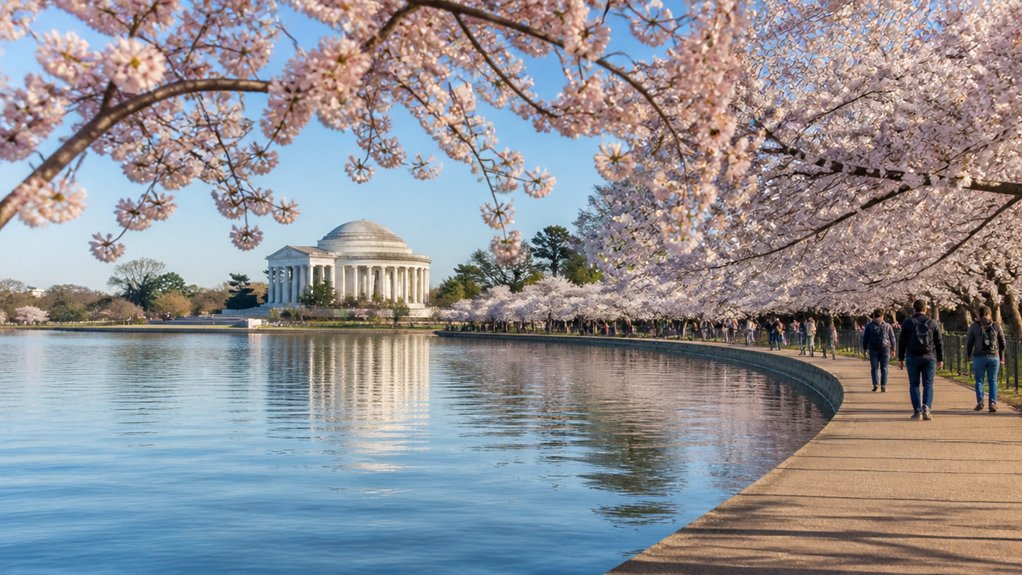
When the Tidal Basin hits peak bloom in late March or early April, you’ll find the shoreline wrapped in pale pink petals for about two weeks, though the exact dates shift each year. If you time your visit with the National Cherry Blossom Festival, you’ll see DC at its most photogenic, with still water, fluttering petals, and camera shutters clicking nonstop.
For a richer walk, start near the Japanese Lantern, where the first 1912 trees were planted, then look for the 1957 stone pagoda. You’ll get especially full canopies around the FDR Memorial and near the Jefferson and MLK Jr. memorials. Sunrise gives you softer light and fewer crowds. Rangers sometimes lead free bloom walks, and a seasonal welcome center may appear on the Jefferson Memorial’s south lawn. The nearby Martin Luther King, Jr. Memorial honors Dr. King’s legacy and struggle for freedom, equality, and justice. Wear shoes that can handle puddles.
Tidal Basin Hours, Parking, and Metro
After you’ve admired the cherry blossoms, the next question is simple: how do you time your visit and get here without hassle?
The Tidal Basin keeps things easy, especially if you’re already exploring the National Mall. Plan around these basics:
- Grounds open daily from dawn to dusk, year-round.
- Rangers usually appear seasonally, about 9:30 a.m. to 6:00 p.m.
- Parking sits by 1501 Maine Ave SW, but fills fast in blossom season.
- Smithsonian Metro is the easiest backup and only a short walk away.
- Give yourself 60 to 90 minutes for the 1.8 to 2.0 mile loop.
You’ll cover memorial views, water reflections, and busy paths without feeling rushed. If you like extra context, check seasonal ranger walks or audio tours before you go. Your feet will thank you later, probably. For a quieter nature detour nearby, Theodore Roosevelt Island offers miles of trails through wooded uplands and swampy bottomlands.

DC's Monuments & Landmark Guided Small Group E-Cart Tour
This tour is a great alternative to see DC's Monuments by a E-Cart and knowledgeable guide. This tour offers a detai...

Washington, DC: Sunset & After-Dark Monuments Tour by E-Cart
Please Note: The 6:00 PM tour may not be fully dark depending on the season. The 8:30 PM tour offers a fully after-d...

DC: US Capitol & Library of Congress/Supreme Court Guided Tour
Discover the heart of American democracy, and pick from our 3 or 4-hour Capitol Hill experience — including timed...
Tidal Basin Costs and Pedal Boats
If you’re wondering about the budget, the good news is simple: walking the Tidal Basin and visiting its memorials is free all year, with no entrance fee or reservation to fuss over.
If you want more than a stroll, rent a pedal boat from Adventures Unbound and see the water at a slower, splashier pace. Rates change by season, but a typical one-hour booking runs about $30 per group. If you’re watching costs, taking Metro to Smithsonian can spare you parking fees. For travelers planning an overnight stay, some National Mall hotels also make it easy to reach the Tidal Basin on foot. Driving is possible too, with parking near the Basin. There aren’t restaurants right along the shore, so grab snacks before a longer outing or check food trucks by the National Mall. Restrooms sit at the MLK Jr. bookstore, FDR bookstore, Jefferson Memorial, and the Paddle Boats kiosk nearby.
What to Pack for the Tidal Basin
Start with comfortable, waterproof walking shoes because the Tidal Basin loop covers about 1.8 to 2 miles, and low spots near the water can get soggy fast. Then pack smart so your walking tour feels easy, not overloaded. You’ll want a few basics close at hand.
- Refillable water bottle and a snack, since restaurants aren’t on the loop.
- Phone, headphones, and a portable charger for audio guides with multiple stops.
- Sunscreen, sunglasses, and a hat for bright glare off the water.
- Light layers or a jacket because temperatures shift quickly across seasons.
- Small umbrella or rain jacket, plus wipes and a compact bag.
A crossbody or small backpack keeps everything tidy while you move between memorials, blossoms, and breezy waterfront views. Your shoulders will thank you later. If you plan to continue exploring afterward, packing light also makes it easier to head toward the nearby Capitol Riverfront waterfront neighborhood.
Hidden Spots, Safety, and Closures
While the Tidal Basin feels calm and easygoing, it works best when you stay flexible and keep an eye on conditions. Parts of the 1.8 to 2 mile walkway sometimes close for maintenance, so check NPS signs or ask at a ranger station before you set out.
You’ll find quieter corners between the monuments and memorials, but the path can flood in wetter months. Stay back from the edge and expect detours. A relaxed loop usually takes 60 to 90 minutes. Don’t swim, and don’t feed the wildlife. If you want water time, rent a pedal boat instead. Restrooms sit at the MLK Jr. and FDR bookstores, the Jefferson Memorial, and the Paddle Boats kiosk. During cherry blossom peaks, go at sunrise. Crowds get wild. Some closures happen then, too.
The nearby World War II Memorial is open daily and honors service and sacrifice during World War II.
Frequently Asked Questions
Can You Bring Dogs to the Tidal Basin?
Yes, you can bring dogs to the Tidal Basin if you follow Pet policies: keep them leashed, clean up waste, avoid the water, and visit during quieter times so your dog doesn’t get overwhelmed.
Are There Restrooms Around the Tidal Basin?
Yes, you’ll find Restroom Locations around the Tidal Basin at the Jefferson, FDR, and MLK memorial bookstores. You can also use seasonal portable toilets near paddle boats and parking; ask rangers if you need directions.
Is the Tidal Basin Wheelchair Accessible?
Yes, you can navigate most of it by wheelchair using accessible pathways on the 1.8–2.0 mile loop. You’ll find ramps, curb cuts, accessible restrooms, and Metro access, though crowds, flooding, and uneven spots can slow you.
Can You Fish in the Tidal Basin?
No—you can’t fish in the Tidal Basin; the water’s a closed curtain. You must follow Catch regulations, and NPS rules ban fishing here. For legal angling, head to approved Potomac spots with required licenses nearby.
Are Ranger-Led Programs Offered at the Tidal Basin?
Yes—you’ll often find free ranger-led programs at the Tidal Basin during peak season. Check Ranger schedules on-site or festival listings. You can join talks on memorials, basin history, and Japanese gifts; off-hours, use self-guided tours.
Conclusion
Walk the full Tidal Basin loop and you’ll cover about 2 miles, yet it feels bigger because every turn changes the view. You’ll hear water slap the seawall, catch stone glowing at Jefferson and FDR, and spot the lantern and pagoda tucked near the path. Start at dawn if you can. The light is softer, the crowds are thinner, and your camera gets the rare gift of calm. Even the ducks seem less opinionated then.
DC in Spring: Cherry Blossom & Tidal Basin Memorials Walking Tour
This guided walking tour explores Washington, DC’s cherry blossom history while visiting some of the most meaningful memorials along the Tidal Basin...
Sunset Monuments and Memorials National Mall Walking Tour
Experience Washington, DC’s most iconic monuments at sunset. Join an expert guide along the National Mall to see t...

Washington DC Monuments and Memorials Night Tour
See Washington, DC in ways large bus tours can’t—especially after dark. This small‑group night tour (12 guests...

DC Monuments by Night: 10+ Landmarks | Open-Top Upgrade Available
See a different side of Washington DC after dark on a guided night tour of the city's floodlit monuments. This tour...
Experiences to explore
 Explore experience ↗
DC in Spring: Cherry Blossom & Tidal Basin Memorials Walking Tour
◷ 1 hr 45 min
This guided walking tour explores Washington, DC’s cherry blossom history while visiting some of the most meaningful memorials along th
From $39.00 USD
View dates Explore experience ↗
Tidal Basin Walking Tour of Thomas Jefferson FDR, MLK Memorials
◷ 2 hr
Experience a fully guided walking tour that takes you to three of Washington D.C.'s most iconic memorials: the Jefferson Memorial, the
See dates for Current pricing
View dates Explore experience ↗
The DC Cherry Blossom Bus Tour with Tidal Basin Guided Walk
◷ 4 hr
Enjoy the fragrant, fluffy blooms of the famous Washington cherry blossom with this short springtime tour, which includes a guided walk
See dates for Current pricing
View dates

2 Comments
[…] Park Service states that all major monuments and memorials are wheelchair accessible. Around the Tidal Basin, the path is level and wheelchair accessible. Accessible restrooms are available at the monuments, […]
[…] a closer look at the landmark itself, a Tidal Basin Washington DC Guide is a useful companion when choosing which part of the waterfront to prioritize. Here, the […]