Like a scene set between giants, the World War II Memorial draws you into a broad plaza of stone, water, and quiet force on the National Mall. You’ll find it between the Lincoln Memorial and the Washington Monument, open day and night, with rangers on hand daily. Start with the Rainbow Pool, then notice the 56 pillars and the wall of gold stars. Look closer, and a few small surprises begin to appear.
Key Takeaways
- The World War II Memorial sits on the National Mall between the Lincoln Memorial and Washington Monument, at the east end of the Reflecting Pool.
- Open 24/7 and free, it is reachable via Smithsonian or Federal Triangle Metro stations, with nearby bus service and NPS ranger programs daily.
- Start at the Rainbow Pool, then circle the 56 granite pillars and view the Atlantic and Pacific Victory Pavilions framing key Mall vistas.
- Don’t miss the 24 bronze relief panels, symbolic floor medallions, and the hidden “Kilroy was here” etching within the memorial details.
- The Freedom Wall’s 4,048 gold stars honor more than 400,000 Americans who died, making it the memorial’s most solemn focal point.
Plan Your World War II Memorial Visit
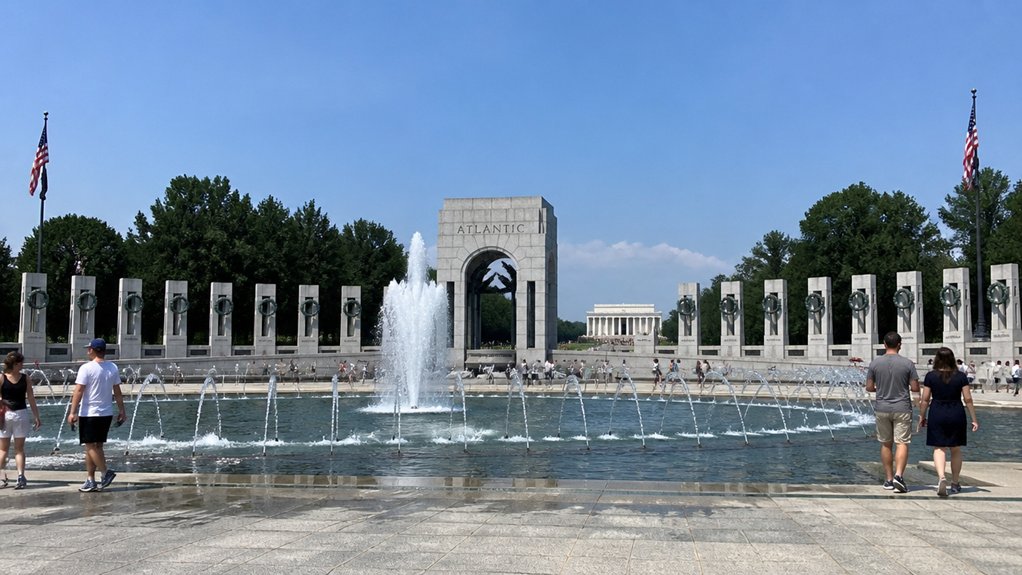
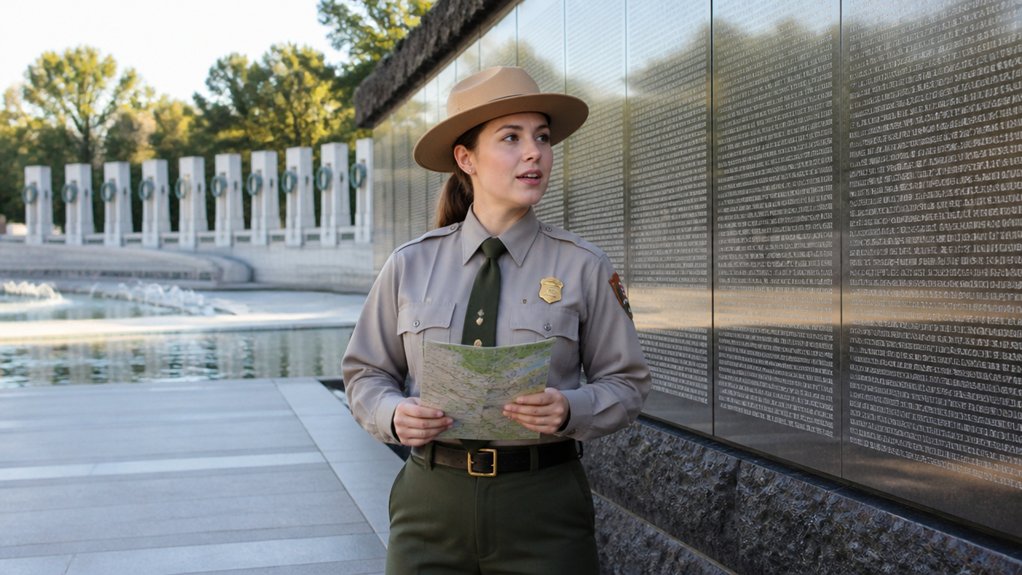
At the heart of the National Mall, the World War II Memorial is easy to fit into your day and worth slowing down for. You can visit 24 hours a day, and admission is free, so it’s one of the easiest stops on your National Mall plan. Rangers are on duty daily from 9:30 a.m. to 10:00 p.m., and they offer interpretive programs throughout the day.
Give yourself enough time to notice the memorial’s standout features. The Rainbow Pool adds motion and soft water sounds, with seating nearby when you want a break. The Freedom Wall holds 4,048 gold stars, each marking 100 American lives lost. Two 43-foot victory pavilions honor the Atlantic and Pacific theaters. If an Honor Flight ceremony is happening, linger. You won’t regret it.
The memorial also recognizes the World War II Home Front as part of the broader American effort during the war.
Where the World War II Memorial Is
On the National Mall, the World War II Memorial sits in one of Washington’s most recognizable spots, between the Lincoln Memorial and the Washington Monument at the east end of the Reflecting Pool.
When you arrive, you’re right on the Mall’s central vista, in the stretch between 17th and 18th Streets NW. The setting feels deliberate and grand. You can look west toward the Lincoln Memorial, then turn and catch the Monument rising behind you. The World War II Memorial anchors that view with a broad plaza, a rainbow pool, and a sweeping ring of 56 pillars. Water sounds soften the city noise, and the stone underfoot gives the place a calm, weighty feel. If you’re finding your way around the city, you’ll find it in the heart of Washington, D.C., impossible to miss once nearby. Nearby, the Korean War Veterans Memorial stands southeast of the Lincoln Memorial and is known for its Freedom Is Not Free motto.
Hours, Access, and Rangers
Because the memorial never really closes, you can visit whenever the Mall fits your day, whether that means a quiet sunrise walk or a late-night stop after the crowds thin out. Admission is free, and the Memorial sits open 24 hours a day all year.
Open day and night, the memorial welcomes quiet sunrise visits, late-night stops, and every moment in between.
- Rangers are on duty daily from 9:30 a.m. to 10:00 p.m.
- You can ask questions or join interpretive programs.
- Metro riders can use Smithsonian or Federal Triangle stations.
- Buses 32, 34, and 36 stop nearby.
You’ll find maps, alerts, and schedules in the NPS mobile app, which saves time when the Mall feels huge. Accessibility resources also help you plan a smoother visit. The memorial is part of America’s Front Yard, an area the National Park Service describes as where the nation comes to remember and history is made. If you’re following tour guides, look for Stop 10 and keep walking. The fountains do the rest.
What the World War II Memorial Honors
Memory takes a big shape here. As you look around, you see what the War II Memorial honors: the 16 million people who served in the U.S. Armed Forces during World War II. It also remembers more than 400,000 Americans who died. Their loss feels stark and immediate, not distant or dusty.
You also notice that the tribute reaches beyond the battlefield. It recognizes the Home Front, where civilians built planes, grew food, and kept daily life moving under strain. The memorial ties those efforts to a bigger idea of national unity and shared sacrifice. It also celebrates Allied victory in both the Atlantic and Pacific campaigns. As you stand here, the place asks you to think big. Then it quietly reminds you that history was personal, too, for every family. Nearby, the Franklin Delano Roosevelt Memorial expands that era’s story through twenty-two quotations engraved in red granite walls.
World War II Memorial Layout and Features
As you enter the central plaza, you’ll notice the Rainbow Pool and fountain setting a calm center where you can pause, look around, and get your bearings. Around you, 56 granite pillars, the tall Atlantic and Pacific pavilions, and the Freedom Wall shape the space with weight, symmetry, and a clear sense of unity. If you look closer, you’ll spot bronze reliefs, sweeping views, and even a hidden “Kilroy was here,” which gives the memorial a small wink amid its solemn scale. Like other major memorial sites overseen by the National Park Service, features such as current conditions and alerts can help visitors plan their visit.
Central Plaza Design
At the heart of the memorial, the central plaza draws you in with a calm, open sweep around the Rainbow Pool, a reflecting fountain whose soft spray and ring of seating create a quiet place to pause.
As you stand in the central plaza, a few details sharpen the experience:
- The Rainbow Pool anchors the space with shimmer and gentle sound.
- Curving granite forms define the plaza’s broad, semi-circular shape.
- The Freedom Wall adds a solemn note at the edge.
- Victory pavilions frame your view to north and south.
Like the reflective spaces described in a Visitor’s Guide, this central layout encourages quiet remembrance through open design and gentle movement. You move easily through this open design, and everything feels balanced. Bronze scenes nearby add motion and story without crowding your path. The plaza stays serene, yet it never feels empty. It invites you to look, listen, and linger a little longer.
Pillars Arches And Wall
From the open calm of the central plaza, your eyes naturally lift to the ring of granite pillars and the great arches beyond. Fifty-six pillars curve around you, one for each state, territory, and the District of Columbia recognized then. They alternate sides by admission order. Their hollow centers quietly suggest lives cut short, while a heavy bronze rope links them in a clear symbol of unity.
At the north and south entries, 43-foot victory arches honor the Atlantic and Pacific theaters. Eagles and laurel wreaths crown each pavilion. Along the approach walls, bronze reliefs show wartime scenes and homefront effort. Nearby, the Freedom Wall carries 4,048 gold stars. Each stands for 100 American dead. Look closely, and you might even spot a discreet Kilroy was here etched in granite nearby. Visitors often pair this stop with Arlington National Cemetery when exploring major memorial sites from Washington DC.
Reliefs Fountain And Views
Water draws you in first. The rainbow pool and fountain anchor the plaza with soft sound and motion, and you’ll find seats circling the edge when you want a quiet pause. From here, the north Atlantic and south Pacific pavilions rise 43 feet high and set the memorial’s main sightlines.
- Watch the water catch light through the day
- Spot the granite pillars curving around the plaza
- Find the bronze relief scenes on the entry walls
- Turn toward the Freedom Wall and its gold stars
As you move around the fountain, the semi-circular colonnades frame the Lincoln Memorial one way and the Washington Monument the other. The bronze relief panels show battle, sacrifice, and homecoming. Then the Freedom Wall delivers a still, unforgettable finish beside the water. The memorial also sits within National Mall, where more iconic monuments and memorials extend across downtown Washington, D.C.
World War II Memorial Pavilions and Reliefs
As you approach the plaza, the two 43-foot Victory Pavilions catch your eye first, standing north and south like proud bookends to the story. Step closer and you’ll spot the bronze relief panels along the entry walls, where scenes of mobilization, battle, and homecoming unfold in crisp metal detail. You can read these features almost like a visual guide, and if you look carefully, the whole setting starts to feel connected by purpose, memory, and a few quietly powerful symbols. For many visitors using a National Mall guide, these pavilions and reliefs become one of the memorial’s most memorable first impressions.
Victory Pavilions
Step into the World War II Memorial plaza and the two 43-foot victory pavilions instantly set the scene. You enter through the north Atlantic pavilion or the south Pacific pavilion, and each feels ceremonial without feeling stiff. Their height anchors the semicircular colonnade and frames your sightline toward the Lincoln Memorial and Washington Monument. Beyond the plaza, the Washington Monument rises as a 555-foot marble obelisk honoring George Washington, the first president of the United States.
- North pavilion marks the Atlantic theater
- South pavilion honors the Pacific theater
- Four bald eagles lift garlands and a laurel wreath
- Floor medallions echo the WWII service medal
Look up and you’ll spot the sculptural baldacchino, where four American bald eagles support victory’s wreath. Then glance down. Nike stands on Mars’ helmet in the floor medallions, a crisp symbol borrowed from the universal service medal. It’s grand, readable, and surprisingly easy to take in quickly.
Bronze Relief Panels
Story takes over when you reach the bronze relief panels that flank the victory pavilions. As you enter from 17th Street NW, you’ll find 24 bronze bas‑relief panels, 12 on each side, turning history into a walk you can follow with your eyes and fingertips. Many scenes come from period photographs, so the faces and motions feel strikingly real today.
On the left, toward the Pacific arch, you trace a servicemember’s path from physical exams to deployment and homecoming. On the right, the story moves through the Atlantic and Pacific theaters, industry, agriculture, troop movements, combat, and veterans returning. Look closely near the reliefs and you might spot a hidden “Kilroy was here.” It’s a small wink from wartime America, tucked into stone for sharp-eyed visitors. Nearby, the Lincoln Memorial honors Abraham Lincoln as an enduring symbol of unity, strength, and wisdom.
World War II Memorial Freedom Wall
Remembrance takes a vivid shape at the Freedom Wall, where 4,048 gold stars shimmer beside the World War II Memorial’s central rainbow pool. As you stand there, the gold stars catch the light and turn loss into something you can count, if not fully grasp. Each star honors 100 Americans.
At the Freedom Wall, 4,048 gold stars make sacrifice visible, each one honoring 100 Americans lost in World War II.
- 4,048 stars represent more than 400,000 fallen service members
- The wall curves within the memorial’s semi-circular plaza
- Battle names and campaign destinations deepen the story
- Rangers often explain its meaning during Honor Flight visits
You’ll notice how the inscriptions sharpen the scale of sacrifice without overwhelming the space. Water moves nearby. Voices usually soften. During guided talks, you hear how the Freedom Wall ties grief to national unity. Many visitors pair this stop with the nearby Washington Monument, where ticket info can help you plan the timing of your visit. It’s solemn, beautiful, and impossible to rush past without pausing for a moment.
What to See Near the Memorial
Once you’ve taken in the quiet weight of the Freedom Wall, the memorial’s setting comes into focus just as strongly. You stand between giants here. The Lincoln Memorial rises west across the Reflecting Pool, while the Washington Monument anchors the eastern skyline. That long, open vista gives your walk a cinematic feel. First-time visitors often pair this stop with the Lincoln Memorial for its monumental setting and strong views back across the Mall.
| Spot | Direction | Why look |
|---|---|---|
| Lincoln Memorial | West | Grand columns and Reflecting Pool views |
| Washington Monument | East | Clean lines and iconic skyline marker |
| Challenger Memorial | Nearby | Quiet stop with space age echoes |
| Columbia Memorial | Nearby | Another reflective point on the Mall |
You’re also near Smithsonian and Federal Triangle Metro stations. For broader context, you can later explore Founders Plaza and the US Freedom Pavilion in New Orleans too.
World War II Memorial Visitor Tips
Plan to linger a bit, because this memorial rewards a slow lap more than a quick photo stop. You can enter the Memorial anytime since it’s open 24 hours, and rangers are on duty from 9:30 a.m. to 10 p.m. Admission is free.
Linger here awhile—this memorial opens all day, costs nothing, and rewards more than a hurried pass.
- Begin at the Rainbow Pool, then circle the 56 hollow granite pillars.
- Stand at the Freedom Wall and count the mood before the 4,048 gold stars.
- Look up at the Atlantic and Pacific pavilions, each rising 43 feet.
- Hunt for the hidden “Kilroy was here” marks if your eyes are sharp.
You’ll find the site between Lincoln and the Washington Monument, near Smithsonian or Federal Triangle. Read the battle names, study bronze reliefs, and remember those who served there with quiet care. If you’re continuing your National Mall visit, a first-time guide to the Jefferson Memorial can help you plan another thoughtful stop nearby.
Frequently Asked Questions
Who Designed the World War II Memorial?
You can credit architectural designer Friedrich St. Florian with designing the World War II Memorial; he won the national competition, and you’d also recognize the landscape architect and artists who helped bring the memorial’s major features to life.
When Was the World War II Memorial Dedicated?
It was dedicated in May 2004, a torch in your memory. As you explore Veterans’ Stories and Memorial Symbolism, you see how the site honors 16 million who served and more than 400,000 who died.
How Much Did the World War II Memorial Cost?
It cost about $182 million to build. You can trace the memorial’s construction cost to private funding sources, including individuals, veterans’ groups, and corporations, since donors—not Congress—financed the project before it opened in 2004.
Why Is There a Rope Connecting the Granite Pillars?
Like a chain is only as strong as its weakest link, you see the rope connecting granite pillars to symbolize unity, using nautical symbolism, while preserving visitor accessibility and showing shared sacrifice among states, territories, and D.C.
Are There Annual Ceremonies Held at the Memorial?
Yes, you’ll find annual ceremonies at the memorial on Memorial Day, Veterans Day, and D-Day anniversaries. You can also see wreath layings, flag presentations, Honor Flight gatherings, speeches, and occasional musical performances honoring veterans.
Conclusion
Even if memorials aren’t usually your thing, this one earns your time. You can walk in at any hour, hear the fountain, trace the granite pillars, and stand before 4,048 gold stars that make the scale of loss suddenly real. Come at sunrise for softer light or after dark for a calmer mood. Then turn and catch the long view to Lincoln and the Washington Monument. It’s easy to pair with nearby stops, and hard to forget.