
You step off the National Mall and spot the Hirshhorn’s bold concrete ring rising like a modern art spaceship. Inside, free galleries wrap around a quiet rotunda, and the mood shifts fast from huge murals to strange videos to rooms that seem to hum with ideas. It’s easy to visit in 90 minutes, but the details can pull you in longer. A few smart tips can make your stop much better.
Key Takeaways
- The Hirshhorn is Smithsonian’s modern and contemporary art museum on the National Mall at 7th Street and Independence Avenue SW.
- Admission is free; typical hours are Tuesday–Sunday 10:00 AM–5:30 PM and Monday noon–5:30 PM, except December 25.
- Prioritize standout works like Mark Bradford’s Pickett’s Charge, OSGEMEOS: Endless Story, Laurie Anderson’s Four Talks, and Jessica Diamond’s Wheel of Life.
- The museum’s circular layout has two gallery levels around a central rotunda, with elevators, accessible restrooms, and free loaner wheelchairs.
- Take Metro to Smithsonian station; the Sculpture Garden is closed for revitalization through 2026, so check tours and timed-entry details online.

Smithsonian "Big 3" Highlights Tour (Air & Space Entry Included)
See the best of the Smithsonian Museums on a 3-hour guided tour of the highlights of the American History, Natural History, and Air and Space Museums...

Private Washington DC City Tour
Make this spring unforgettable with a private Washington DC tour designed just for your family, perfectly timed for...

Washington DC Hop-On Hop-off Trolley Tour with 15 Stops
Enjoy a 90-minute Hop-on Hop-off panoramic trolley tour of Washington, DC. The tour route will maximize your time an...
What Is the Hirshhorn Museum?
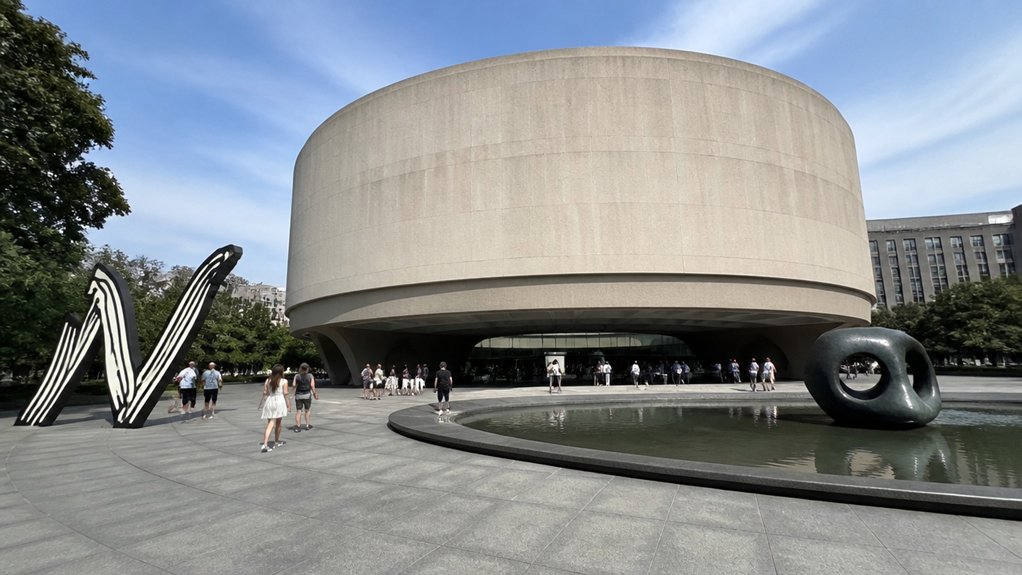
Think of the Hirshhorn Museum as Washington’s round house for modern art. You step into a Smithsonian space built to spark curiosity, with a bold cylindrical design and galleries filled with painting, sculpture, photography, and new media. Founded in 1974 by collector Joseph H. Hirshhorn, it now holds more than 12,000 works.
The Hirshhorn Museum and Sculpture Garden focuses on shared experiences between artists, art, and you. Inside, rotating exhibitions and permanent displays keep each visit fresh. Outside, the sunken garden adds a quiet, almost secret feeling, with major works like Rodin’s The Burghers of Calais and David Smith’s Cubi XII. Best of all, admission stays free all year. You can also join free tours, lectures, films, and digital programs without spending a dime. The museum also offers artist-focused talks and audio features that bring ideas from the galleries to your earbuds.
Where Is the Hirshhorn Museum in DC?
You’ll find the Hirshhorn right on the National Mall at 7th Street and Independence Avenue SW, in that bold round building you can’t really miss. If you’re taking Metro, hop off at Smithsonian on the Blue, Orange, or Silver lines and you’re just a short walk away. As you get closer, look for the entrance between Jefferson Drive and Independence Avenue, with the sunken Sculpture Garden beside it like a quiet surprise in the middle of the city. Like Union Station, the Hirshhorn is one of DC’s standout landmarks and is easy to pair with other major sightseeing stops in the city.
National Mall Location
On the National Mall, the Hirshhorn Museum and Sculpture Garden sits at the corner of 7th Street and Independence Avenue SW, right in the middle of Washington’s museum core.
You’ll spot its bold cylindrical shape quickly, rising from a prime Smithsonian location near the U.S. Botanic Garden and the National Gallery. The main entrance faces the Mall, so it feels woven into the city’s grandest stretch of museums and monuments. On the Independence Avenue side, the sunken 1.3 acre Sculpture Garden adds a quieter counterpoint with paths, plantings, and art below street level. If you’re already exploring nearby landmarks, you can usually reach the Hirshhorn Museum and Sculpture Garden in about 5 to 15 minutes on foot. That central setting makes it easy to fold modern art into a classic Washington day without extra planning. As part of the National Mall, the museum is especially easy for first-time visitors to include while exploring Washington’s most iconic sights.
Nearby Metro Access
From the Smithsonian Metro station, the Hirshhorn is an easy, short walk across the Mall. You’ll use the Blue, Orange, or Silver lines, then head toward the museum’s unmistakable circular form. As you come up from Smithsonian, look for the bold cylindrical building and the sunken Sculpture Garden nearby. They make handy landmarks, especially if your phone decides to be unhelpful.
If you prefer surface transit, Metrobus routes 32, 34, and 36 stop in the National Mall area close to the museum. You can also check the System Status before heading out in case service changes affect your route. That gives you a simple backup if the train timing doesn’t work for your plans. You can also pair Metro with a nearby garage, such as L’Enfant Plaza or Capital Gallery, if you’re driving part of the way. For most visitors, though, Smithsonian keeps things easiest and stress light.

Hop-On Hop-Off Double Decker Tour & Arlington Cemetery Audio Tour
As the Official Tour Provider of the National Mall, Big Bus gets you closer than anyone else to the monuments and me...

Stretch Limo Private Day & Night Custom Tours of Washington DC
Looking for private tour of Washington DC? Explore Washington with Five Star Limo Service. This perfectly sanitized...

Luxury SUV Private Day or Night Tour of Washington DC
Looking for Washington DC private tours? Explore DC with World’s Five Star Limo Service. This SUV Tour is for up t...
Entrance And Streets
The Hirshhorn Museum and Sculpture Garden stands right on the National Mall at 7th Street and Independence Avenue SW, so it’s easy to spot once you’re in the area. You’ll notice the bold circular building first. It faces an open plaza and the sunken Sculpture Garden, which is closed for revitalization through 2026.
- Enter at street level through the reconfigured lobby.
- Stop by the Welcome Desk for guides and quick help.
- Log onto the free wi-fi before you start wandering.
- If you drive, use nearby garages at L’Enfant Plaza or Capital Gallery.
You won’t find dedicated museum parking, but metered spaces line Jefferson Drive SW. If you arrive by transit, Smithsonian is closest, and Metrobus routes 32, 34, and 36 also stop nearby along Avenue SW. If you plan to keep exploring the area afterward, the nearby Capitol campus covers 570 acres of grounds and includes extensive buildings, art, and visitor resources.
What Are Hirshhorn Museum Hours and Admission?

Usually, you can walk into the Hirshhorn without buying a ticket, which feels like one of Washington’s best art-world bargains. The Hirshhorn Museum and Sculpture Garden is free year-round because it’s part of the Smithsonian. Most days, you can visit Tuesday through Sunday from 10:00 AM to 5:30 PM, while Monday hours usually run noon to 5:30 PM. It closes on December 25, and temporary schedule changes do happen.
Before you head in, check the museum website if you want a special exhibition, since some shows need timed-entry passes or reservations. Free guided tours often start around 11:30 AM daily. At the Welcome Desk, you can also pick up visitor guides and Kids guides for a suggested $2 donation. It’s an easy, low-stress stop. Keep in mind that admission is free for galleries, exhibitions, and guided tours, though some events may require free registration.
When Is the Best Time to Visit Hirshhorn?
When should you go if you want the Hirshhorn at its calmest? Aim for weekday mornings, especially Tuesday through Thursday, right after the museum opens at 10:00 AM. The galleries feel airy then, and you can move at your own pace instead of weaving through clusters of visitors.
- Choose Tuesday to Thursday mornings for the lightest crowds.
- On Monday, arrive after noon, since school groups often fill earlier slots.
- Try 4:00 to 5:00 PM for a quieter late-day visit before 5:30 closing.
- Give yourself 90 minutes, and check the calendar for buzzy exhibitions or artist talks.
As one of the best museums in Washington DC, the Hirshhorn can draw bigger crowds during peak tourist periods. If you’re dreaming of the Sculpture Garden, plan ahead for its expected 2026 reopening. Once it returns, weekdays should give you the best chance at a calmer outdoor stroll.
How Do You Get to the Hirshhorn Museum?
Getting there is surprisingly simple once you’ve picked your quiet window. In Washington DC, you’ll find the Hirshhorn on the National Mall at 7th Street and Independence Avenue SW, near the Smithsonian Castle. Take Metro to Smithsonian station on the Blue, Orange, or Silver lines. You can also ride Metrobus routes 32, 34, or 36. If you’re planning a broader day on the Mall, the nearby Library of Congress is another major Washington research and cultural landmark to know.
| Option | What to know |
|---|---|
| Metro | Smithsonian stop |
| Bus | Routes 32, 34, 36 |
| Garage | L’Enfant Plaza |
| Garage | Capital Gallery |
| Street | Jefferson Drive meters |
If you drive, use a paid garage or try metered parking on Jefferson Drive SW. Enter through the street-level lobby. Before you go, check hours, reserve timed passes for select shows, and confirm Sculpture Garden access online first.
Still comparing Hirshhorn Museum Washington DC?
Ask for tour ideas, hotel suggestions, or a simple trip plan that combines both.
Trip Helper
Is the Hirshhorn Museum Accessible and Family-Friendly?
You’ll find the Hirshhorn easy to navigate, with wheelchair access throughout, accessible restrooms on every floor, and free loaner wheelchairs if you want a little extra help. If you’re visiting with kids, you can pick up a Hirshhorn KIDS booklet or a self-guided tour packed with scavenger hunts, coloring, and drawing prompts that keep small hands busy. Strollers are welcome, free family-friendly tours and drop-in programs add structure to your day, and the Sculpture Garden is worth checking for current status before you go. If you’re planning to pair your museum stop with the Library of Congress, remember that free timed-entry tickets are required for entry.
Accessibility Features
Happily, the Hirshhorn makes access feel simple from the start. You’ll find an accessible visit here, with step-free entrances, elevators reaching every gallery, and accessible restrooms on each floor. If you need extra support, you can bring a service animal and contact the accessibility team at [emailprotected] before your visit.
- Step-free entrances help you glide inside without barriers.
- Elevators connect every gallery, so you won’t miss a floor.
- Accessible restrooms appear on each level for easier planning.
- Stroller-friendly routes and free Wi‑Fi keep navigation smooth.
At the Welcome Desk, you can pick up printed guides for easy orientation. Keep bags light, since security screens all items. You can take photos, too, as long as you skip flash, tripods, and selfie sticks near artworks. If you’re also exploring D.C. museums, the nearby National Building Museum is another welcoming stop to consider.
Family-Friendly Amenities
Often, the Hirshhorn feels easy for families from the moment you roll in with a stroller or map out a wheelchair-friendly route. You’ll find restrooms on every floor, accessible entrances, and galleries designed for smooth movement, which makes the museum genuinely family-friendly.
To keep kids curious, you can grab the Hirshhorn KIDS booklet or a self-guided kids brochure at the Welcome Desk for a suggested $2 donation. Expect scavenger hunts, simple activities, and prompts that turn art into a game. Free guided tours and drop-in family programs pop up regularly, so it’s smart to check the calendar before you go. Like many major Smithsonian-area museums highlighted in a National Gallery guide, the Hirshhorn also rewards a little advance planning if you want to catch family programming at the best time. When snack time hits, head to the lobby level, where food and drinks are allowed. There’s a Dolcezza kiosk and gelato too, which rarely hurts morale.
How Long Should You Spend at Hirshhorn?
Usually, about 90 minutes gives you enough time to tour the Hirshhorn’s three floors and catch the highlights without feeling rushed. If you like to linger, aim for more. Rotating shows can easily stretch your visit, and time in the Sculpture Garden in Washington adds another layer. Like the Smithsonian guide approach used at other National Mall museums, planning ahead can help you make the most of your time.
- Quick highlights: plan 90 minutes.
- Fuller visit: give yourself 2 to 3 hours.
- Tours and programs: add 30 to 45 minutes.
- Families and breaks: tack on 30 to 60 minutes or more.
You’ll want extra time for free guided tours, artist videos, or late-morning programs around 11:30 a.m. If you’re visiting with kids, scavenger hunts can happily slow your pace. And if a shop browse or café stop sounds nice, two hours or more feels just right for most visitors.

Executive Bus Private Day & Night Custom Tours of Washington DC
This Executive mini bus private & custom day or night tour of Washington DC is for up to 32 people. Explore the city...

Custom Private DC City Tour by Sprinter Van – Day or Night
Looking for Washington DC private tours? Explore DC with World’s Five Star Limo Service. This Mercedes Van Tour is...

Washington DC Museums self-guided walking tour & scavenger hunt
This Tourist Scavenger Hunt takes you through the Eastern part of the National Mall where Washington's Museums are l...
What Is the Hirshhorn Museum Layout?
Once you know how much time to set aside, it helps to picture how the Hirshhorn is arranged. You enter through the lobby, where you’ll find the Welcome Desk and easy access to concessions. The Museum is a cylindrical building on the National Mall, with galleries circling a central rotunda on two main levels. You move through inner and outer rings, so navigation feels intuitive, not maze-like. If you’re comparing Smithsonian museums, the National Portrait Gallery offers a very different experience focused on portraiture rather than a circular modern-art layout.
| Area | Where | Use |
|---|---|---|
| Lobby | Entry level | Tickets, info, snacks |
| Galleries | Two main levels | Inner and outer circles |
| Rotunda | Center | Large installations |
| Lower level | Below lobby | Shop and services |
Outside, the sunken Sculpture Garden extends the experience, though it’s temporarily closed for revitalization. Plan about 90 minutes to explore the exhibition floors and rotunda comfortably.
What Are the Top Things to See at Hirshhorn?
If you want a fast read on what makes the Hirshhorn special, start with the works that turn the building itself into part of the experience. You’ll feel how modern and contemporary art can fill walls, reshape light, and change your pace.
- Walk Mark Bradford’s Pickett’s Charge, where eight mixed-media canvases sweep 400 feet around the circular wall.
- Step into Laurie Anderson: Four Talks and move among a raven, parrot, canoe, and shelf layered with stories and lyrics.
- Look up in the lobby for Olafur Eliasson’s prismatic light and Hiroshi Sugimoto’s tree-root-inspired transformation.
- If the Sculpture Garden has reopened, seek Rodin, David Smith, and Yoko Ono. If not, note it’s closed through 2026.
Also watch for OSGEMEOS: Endless Story, packed with nearly 1,000 playful works. If you want to compare DC museum experiences, the National Gallery of Art also offers free images from nearly 60,000 high-resolution works online.
Which Hirshhorn Exhibitions Should You See First?
Start with the museum’s signature hits: Mark Bradford’s Pickett’s Charge wraps 400 feet around the circular walls, and OSGEMEOS: Endless Story surrounds you with nearly 1,000 playful works in one room. Then head to Laurie Anderson: Four Talks early so you can catch its raven, parrot, canoe, and shelf in a quieter multisensory setting filled with songs and stories. After that, check current highlights like Revolutions: Art from the Collection, Jessica Diamond’s Wheel of Life on Level 2, and the rotating list so you can plan your time across all three floors and the Sculpture Garden. If you like pairing museum visits with broader Smithsonian culture, the Air & Space Quarterly magazine highlights stories about the past, present, and future of flight.
Start With Signatures
A good Hirshhorn game plan begins with the museum’s signatures, the works that instantly show you what this circular building does best. Start on Level 2, where Mark Bradford’s Pickett’s Charge wraps the walls for roughly 400 feet and turns your walk into a pulse of torn paper, color, and scale. Then use these anchors:
- Pickett’s Charge for the museum’s big, immersive statement.
- OSGEMEOS: Endless Story for nearly 1,000 playful, surreal works by the Brazilian twins.
- Laurie Anderson: Four Talks for a room-filling mix of sculpture, text, and song.
- Revolutions: Art from the Collection for a clear throughline in modern art.
If the Sculpture Garden is open during revitalization, add Rodin’s *The Burghers of Calais* and David Smith’s *Cubi XII*. They reward even a quick detour. For broader Smithsonian context, the nearby National Museum of American History offers a different lens on how American stories are collected and presented.
Prioritize Current Highlights
Once you’ve hit the Hirshhorn’s signature works, put your time into the shows that match how you like to look. If you want one must-see, head to Mark Bradford’s Pickett’s Charge. Its eight mixed-media canvases wrap nearly 400 feet around the circular wall, so you don’t just view it, you move through it.
For immersive color, choose OSGEMEOS: Endless Story. The Brazilian twins pack in almost 1,000 paintings, drawings, sculptures, and photos, and the rooms feel like a comic book dream. If sound and ideas pull you in, try Laurie Anderson’s Four Talks, where walls, floor, and ceiling join four sculptures in one contemporary environment. Like the National Museum of Natural History, the Hirshhorn rewards visitors who focus on a few standout experiences instead of trying to see everything at once. Short on time? See Jessica Diamond’s Wheel of Life. Want context? Revolutions neatly links 1860 to 1960 with today’s contemporary art practice too.
What Should You Know About the Sculpture Garden?
Why does the Hirshhorn Sculpture Garden feel so different from the rest of the National Mall? You step into a Sculpture space that sinks 6 to 14 feet below street level, so the city suddenly softens. The 1.3 acre layout feels enclosed, calm, and a little secretive. It also sits within National Mall, a park landscape that stretches from the United States Capitol to the Potomac River.
Step down into the Hirshhorn Sculpture Garden, and the Mall’s noise fades into something quieter, enclosed, and almost secret.
- You’ll spot Rodin’s *The Burghers of Calais*.
- You can look for Yoko Ono’s *Wish Tree for Washington, DC*.
- You’ll notice David Smith’s *Cubi XII* catching the light.
- You shouldn’t miss the circular fountain, the garden’s signature centerpiece.
The whole garden connects closely to the museum and echoes Joseph Hirshhorn’s Connecticut estate, built to stir awe and contemplation. It’s also in a $68 million revitalization, with reopening planned for 2026. Even the fountain seems patient.
Does the Hirshhorn Offer Tours and Programs?
Plunge in and the Hirshhorn quickly proves it’s more than a place to drift past sculptures in silence. You can join a free guided tour every day, usually around 11:30 AM, though it’s smart to confirm times online or at the Welcome Desk when you arrive.
If you like hearing artists unpack their work, you’ll find talks and programs that go deeper. Past examples include JR: On Becoming an Artist, On Process with Laurie Anderson, and an Artist Talk with Sterling Ruby. You can also drop into free gallery experiences, family tours, and kid-friendly activities like the Hirshhorn KIDS booklet. Like the National Archives in Washington, D.C., the museum rewards visitors who check the daily schedule for tours and special programming before they go. The museum’s calendar adds lectures, film screenings, and special events, so reserve ahead when needed. Prefer exploring solo? hi.si.edu offers digital guides and behind-the-scenes artist videos too.
What Are the Hirshhorn Shop and Cafe Like?
A quick stop at the Hirshhorn can turn into two small pleasures: a browse and a coffee. From the main lobby, you can easily reach both the museum shop and the Dolcezza kiosk during museum hours.
A quick Hirshhorn detour offers two easy pleasures: a browse in the shop and a coffee in the lobby.
- Head downstairs to the Lower Level for catalogues, books, posters, postcards, DVDs, CDs, apparel, and giftable souvenirs.
- Look for current exhibition merchandise and museum publications, including catalogues tied to shows like Mark Bradford and OSGEMEOS.
- Stay in the lobby for locally sourced espresso drinks, pastries, and handcrafted gelato served from a striking 20-foot metal coffee bar.
- Keep snacks and drinks on the lobby level only, so you won’t be that person wandering the galleries with a latte.
If you’re planning another museum stop in D.C., the National Portrait Gallery offers a free Walk-In Highlights Tour daily from the F Street Lobby.
It’s convenient, compact, and surprisingly tempting before you leave.

Architecture of Washington's National Mall Audio Guide
Uncover the meaning behind some of the most iconic structures in D.C. on this self-guided audio tour. Experience the...

Reflections on a Nation Self-Guided National Mall Highlights Tour
Discover the essence of American ideals on the self-paced National Mall Highlights tour in Washington, D.C. This jou...

Unlimited Water Taxi Pass & Hop-on Hop-off Bus Tour with 18 Stops
Experience DC in a way that’s easy, exciting, and completely flexible. Start your journey on a hop-on hop-off tour...
What Else Can You See Near the Hirshhorn?

Just outside the museum, the National Mall opens up like a ready-made walking tour. You can head east to the Smithsonian Castle in about 10 to 15 minutes, or angle northeast roughly 0.3 miles to the Washington Monument. Nearby, the Freer Gallery of Art, the National Museum of African American History and Culture, and other Smithsonian stops sit within an easy 5 to 15 minute walk.
If you want more art, cross the National Mall and stroll about 0.4 miles to the National Gallery of Art’s West Building. Stay close and you’ll find the Hirshhorn’s circular fountain and sunken Sculpture Garden, a calm break from all that marble. A short walk north brings you toward the Tidal Basin and spring cherry trees. The Smithsonian Metro station sits two blocks north.
Frequently Asked Questions
Can You Take Photos Inside the Hirshhorn Museum?
Yes, you can take photos inside the Hirshhorn Museum. Photography permitted for personal, noncommercial use, so you’ll capture the art without flash or tripods. You should also check signs, because some special exhibitions don’t allow photography.
Are Backpacks or Large Bags Allowed Inside?
Yes, you can bring backpacks or large bags inside, but you’ll need to follow the Bag Policy. Security may inspect your belongings, and oversized items could face restrictions, so you should pack lightly whenever possible.
Does the Hirshhorn Have Coat Check or Lockers?
Yes—you’ll find coat check, but you shouldn’t expect public lockers or full Bag storage. Like a traveler shedding armor before entering a gallery kingdom, you’ll hand over approved items and roam lighter through the museum’s halls.
Can You Bring Food or Drinks Into the Museum?
No food/drinks are allowed inside the museum, so you can’t bring snacks, meals, or beverages with you. You should finish or discard them before entering, then enjoy the exhibits without carrying anything that could spill.
Are Strollers Allowed in the Hirshhorn Galleries?
Yes, you can bring strollers into the Hirshhorn galleries, but you should follow stroller etiquette by keeping pathways clear, staying mindful of artworks and other visitors, and using elevators carefully so everyone’s museum experience stays comfortable.
Conclusion
At the Hirshhorn, you don’t just check off a museum. You circle a concrete drum, step into cool galleries, and meet art that can feel strange, sharp, and oddly personal. One minute you’re watching light shift across the rotunda. The next you’re plotting your route like it’s on a Game Boy map. Go for 90 minutes or linger longer. With free admission and the Mall outside, you’ve got one of DC’s smartest easy stops.
Private Washington DC City Tour
Make this spring unforgettable with a private Washington DC tour designed just for your family, perfectly timed for cherry blossom season. Explore ico...
DC Monuments Night Tour with 10+ Stops, National Mall, Tickets
Experience Washington DC lit up at night during this 3-Hour Guided Night Tour of the National Mall and Monuments. Ma...
Smithsonian "Big 3" Highlights Tour (Air & Space Entry Included)
See the best of the Smithsonian Museums on a 3-hour guided tour of the highlights of the American History, Natural H...