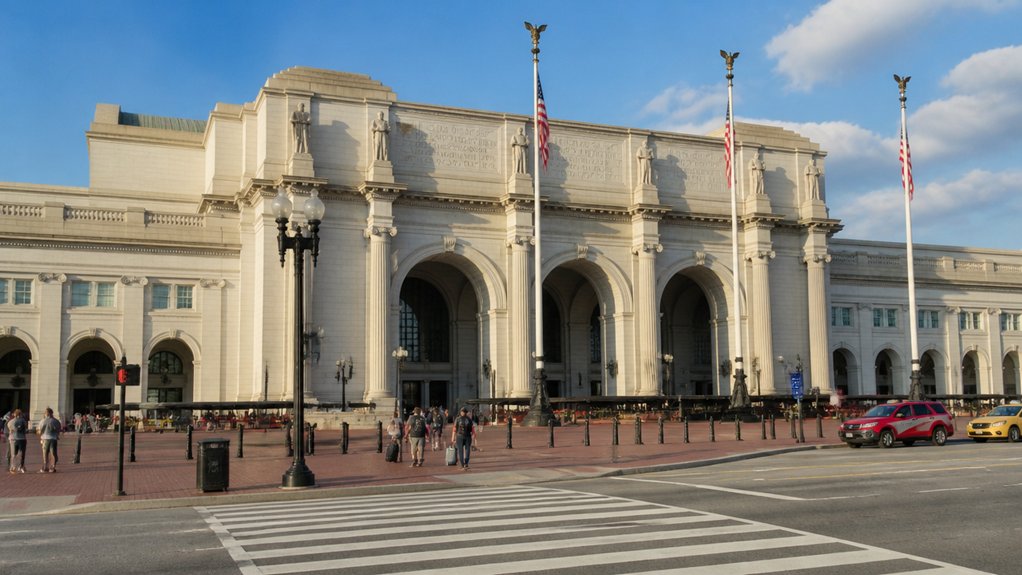
You might not know Union Station was designed to make your arrival in Washington feel ceremonial, not rushed. You step from trains and Metro into a Beaux-Arts hall with a 96-foot gold-coffered ceiling, Roman-style statues, and a clock that boldly uses IIII instead of IV. Then you notice the practical side too: easy Red Line access, parking, food, and shops. The trick is knowing what’s worth your time once you’re inside.
Key Takeaways
- Union Station, opened in 1907, is a restored Beaux-Arts landmark near the Capitol that now welcomes about 40 million visitors annually.
- Don’t miss Main Hall’s 96-foot gold-coffered ceiling, marble floors, 1907 train gates, Roman figures, and clock displaying “IIII.”
- The station is a major transit hub for Amtrak, MARC, VRE, Metro’s Red Line, buses, taxis, ride-hail, and nearby bike-share.
- Union Station offers 100-plus shops and restaurants across three levels, including UNIQLO, Blue Bottle Coffee, Cava, Chipotle, and seasonal pop-ups.
- It’s an ideal starting point for visiting the U.S. Capitol, National Mall, Postal Museum, and Columbus Fountain just outside the station.

Washington DC Hop-On Hop-off Trolley Tour with 15 Stops
Enjoy a 90-minute Hop-on Hop-off panoramic trolley tour of Washington, DC. The tour route will maximize your time and provide you with a great introdu...

Washington DC Neighborhoods Personalized Self-Guided App Tour
World class app-led tour, completely controlled by you!See the best sights in Capitol Hill, at your leisure! Narr...

Washington DC Monuments by Moonlight Tour by Trolley
You haven't seen Washington DC until you've seen it at night! On this evening 100% live narrated tour, you'll enjoy...

Iconic Capitol Hill Architectural Walking Tour
Explore the political core of Washington DC! This tour takes visitors through the heart of Federal power in Washingt...
Why Is Union Station DC Worth Visiting?
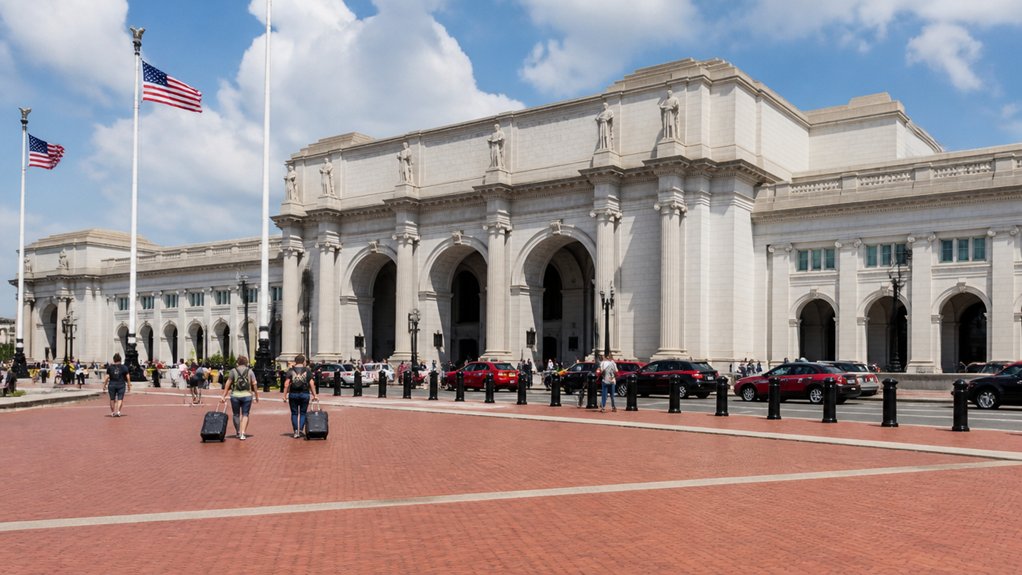
If you think Union Station is just a place to catch a train, the first look inside quickly changes your mind. In the Main Hall, you stand under a 96 foot barrel vaulted ceiling with gold coffers glowing above marble floors. You spot the clock with its unusual “IIII” and the Roman figures watching from the balconies. It feels grand but easy to enjoy, even if you’re only passing through.
Step outside and you’ll find bold public art at Columbus Circle. From here, it is also easy to continue exploring nearby neighborhoods like the Capitol Riverfront along DC’s waterfront. Stay inside and Union Station keeps delivering. You can grab food, browse shops, catch a movie, or use it as a simple launch point for the Capitol, the Mall, Metro, Amtrak, buses, taxis, or bikes. That’s rare travel convenience with real personality and style built in.
What’s the History of Union Station?
Union Station’s story starts with a big civic dream. In Washington, DC, you step into a place born from the McMillan Commission plan. Congress approved it in 1903, and Union Station opened in 1907 to unify scattered rail lines and shape a grander capital. During World War II, you’d have found thunderous crowds here, with more than 200,000 passengers a day. Like the United States Capitol, it stands as a major Washington landmark that helps visitors understand the city’s civic identity.
| Year | Moment | Why it matters |
|---|---|---|
| 1903 | Congress approved construction | You get one central station |
| 1907 | Union Station opened | Washington, DC gained a new gateway |
After rail travel slumped, a failed National Visitor Center chapter nearly dulled its future. Then restoration revived it, and the 1988 reopening turned it into the busy hub you know today, now welcoming about 40 million visitors yearly.
Which Architectural Details Should You Notice?
Step inside after that history lesson and the building starts showing off. You can spot architect Daniel Burnham’s Beaux Arts ambition in the Roman scale and symmetry, borrowed from baths, arches, and empire-sized drama.
Look up first. The Main Hall’s barrel-vaulted ceiling rises 96 feet and glows with gold coffers, egg-and-dart trim, and a balcony guarded by 36 Roman legionnaires. Its grand civic style also fits neatly within Washington’s Federal Triangle era of monumental classical design. Then notice the weight and texture around you. Mahogany woodwork adds warmth. Marble planters sit like calm giants at 10 tons each. Gold leaf catches the light in quiet flashes. Outside, Columbus Plaza and Lorado Taft’s fountain frame the station with flags in admission order. Even the clock gets quirky. It uses “IIII” instead of “IV,” which feels oddly perfect here. It rewards slow looking.
What Are the Best Things to See Inside?
A good first stop is the Main Hall, because it gives you the full Union Station effect in one sweep. In Washington DC, you’ll look up. The 96-foot gold-coffered ceiling, marble floor, 1907 train gates, and balcony of 36 Roman figures make the room feel grand but lived in.
- Spot the Main Hall clock with “IIII,” glowing amid gilding and mahogany.
- Peek into East Hall and the Columbus Club for Pompeii-style fish, fruit, griffins, and the Oval Office-shaped Presidential Suite.
- Find Saint-Gaudens sculptures, then notice the 10-ton marble planters, egg-and-dart molding, and colorful stencils.
If Union Station is part of your day, it pairs well with a first-timer walk through the National Mall, since both reward slow looking and a sense of Washington’s grand civic scale.
You’ll leave seeing Union Station as more than a transit hub. It’s a gallery with footsteps, where every surface seems to wink at you if you slow down a bit.

Hop-on Hop-off Bus Tour with 18 Stops plus Guided Sunset Tour
As the official tour of the National Parks Service, no one gets you closer to the National Mall monuments and the st...

Grand Tour of Washington, D.C.
The Half-Day Grand Sightseeing Tour of Washington DC is your premier sightseeing tour to see all the monuments, muse...

Hop-On Hop-Off Double Decker Tour & Arlington Cemetery Audio Tour
As the Official Tour Provider of the National Mall, Big Bus gets you closer than anyone else to the monuments and me...
How Do You Get to Union Station DC?
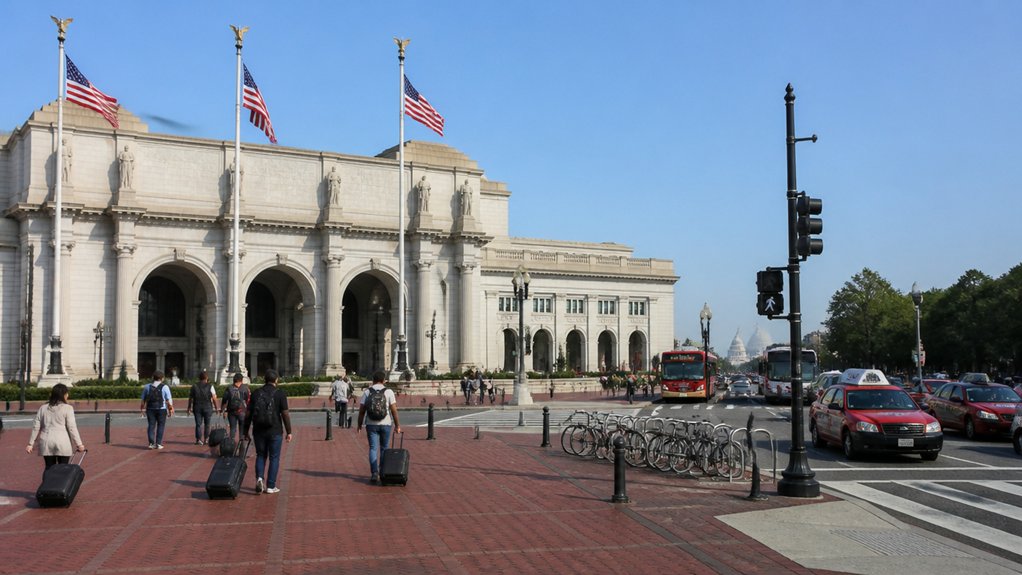
From nearly anywhere in Washington, getting to Union Station feels invigoratingly simple. You’ll find it at 50 Massachusetts Avenue NE, about a half mile from the U.S. Capitol and the National Mall, so you can even walk there if the weather behaves. If you’re driving, the 24 hour garage at 30 Massachusetts Ave NE has more than 2,400 spaces plus EV charging. Cyclists get bike racks nearby and Capital Bikeshare for quick hops.
If you prefer a door to door arrival, taxis use the Main Hall entrance, usually from 8 a.m. to 1 a.m. Ride hail pickup and drop off happen at the Massachusetts Avenue exit. If you’re flying in first, Dulles or Reagan both offer transportation options into downtown Washington before you continue on to Union Station. However you arrive, Union Station feels easy to reach and ready for your next move in the city.
Which Trains, Metro, and Bus Lines Serve It?
Plug into Union Station and you’ll see why it feels less like a single terminal and more like the city’s grand switching point. From here, you can board Amtrak, including Acela and Northeast Regional, or hop on MARC and VRE commuter trains. The Metro’s Red Line stops beneath the Station on one island platform, giving you a quick shot downtown. You can also use Tap. Ride. Go. to pay Metro fare quickly and easily when connecting from the station.
- Intercity and local buses fan out from Union, and many sightseeing tours load here too.
- Taxis queue at the Main Hall entrance, usually from 8 a.m. to 1 a.m.
- Uber, Lyft, car rentals, DC Circulator links, bike parking, and nearby Capital Bikeshare cover your last mile.
You’ll hear rolling bags, brake hiss, and boarding calls. It’s efficient, busy, and oddly fun.
Where Can You Shop and Eat at Union Station?
You can turn a layover into a quick shopping run here, with more than 100 stores spread across three levels, from big names like UNIQLO to local spots like Lees. When you get hungry, you’ve got easy choices from coffee and bagels to fast casual favorites like Cava, Chipotle, Potbelly, and Raising Cane’s. The Main Hall keeps it practical too, since you can grab a meal, hear the station buzz around you, and still make your train or Metro connection without a sprint. Its central location also makes it a convenient stop if you’re staying at National Mall hotels and exploring Washington DC’s top sights.
Retail Highlights
Union Station feels like a travel-day marketplace, with more than 210,000 square feet of retail spread across multiple levels and over 100 shops to explore between trains.
At Union Station in Washington, you can browse shopping and dining options while focusing on the strong retail mix. It also stands out in many Washington DC shopping roundups for pairing travel convenience with a broad mix of national brands and local finds. Look for:
- Big names like UNIQLO for easy wardrobe upgrades.
- Local stops such as Lee’s flower shop for gifts with character.
- Main Hall pop-ups, seasonal markets, and art displays that turn errands into discovery.
Most stores open Monday through Saturday from 10 a.m. to 9 p.m. and Sunday from noon to 6 p.m. Hours can shift by tenant, and major holidays may bring closures. You might arrive for a charger and leave with flowers or a last-minute scarf too.
Dining Options
Hunger usually shows up right around the time shopping bags start to feel heavy, and Union Station makes that timing easy to handle. You can roam more than 100 shops and restaurants across three levels, then grab a quick bite at Raising Cane’s, Cava, Chipotle, Potbelly, Blue Bottle Coffee, Jamba Juice, or Bullfrog Bagels. The Main Hall works especially well as your launch point. It buzzes with food courts, pop-up exhibits, and travelers plotting the next stop near the National Mall. If you want more than lunch, browse local spots like Lees, catch a movie downstairs, or line up a bike or car rental. For a wider taste of the city’s food scene, Union Market is another popular D.C. destination known for local vendors and a community-driven dining experience. Retail hours usually run 10 to 9 Monday through Saturday, while many restaurants open earlier, so breakfast and dinner are easy.

Customizable Guided Express Luxury Tours in Washington DC
For Express drive through and quick stops for Snaps - Explore the iconic landmarks of Washington, DC with our custom...
Iconic Capitol Hill Architectural Walking Tour
Explore the political core of Washington DC! This tour takes visitors through the heart of Federal power in Washingt...
Hop-on Hop-off Bus Tour with 18 Stops plus Guided Sunset Tour
As the official tour of the National Parks Service, no one gets you closer to the National Mall monuments and the st...
What Should You Know About Hours and Parking?
Usually, the easiest way to plan a stop at Union Station is to think in two tracks: shopping hours and parking. Most retail spots are open Monday through Saturday from 10 a.m. to 9 p.m., then Sunday from noon to 6 p.m. Restaurants usually start earlier, around 6 a.m., and keep going until evening. Holidays can trim hours, so check before you roll in.
- Park at the Union Station Parking Garage, 30 Massachusetts Avenue NE, where a 24-hour structure holds 2,400-plus cars.
- If you like certainty, reserve long-term, valet, or guaranteed parking ahead of time. There’s even EV charging.
- For pick-ups, use the Massachusetts Avenue exit. Taxis line up by the Main Hall from 8 a.m. to 1 a.m. daily.
If you’re planning to continue sightseeing nearby, the Supreme Court has a visitor guide that can help you prepare for your stop.
What Can You See Near Union Station?
Once you’ve sorted out parking and timing, the fun part starts the moment you step outside. Right in front of you, Columbus Circle frames the station with District and state flags, plus Lorado Taft’s 1912 Columbus Fountain. Walk a little farther and you’ll reach the Upper and Lower Senate Parks, where reflecting pools, planting beds, fountains, and the Robert A. Taft Memorial sit beside a 100-foot carillon tower.
From there, you’re only five blocks from the U.S. Capitol, and public tours make the detour easy. On the Capitol campus, you can also explore 570 acres of grounds along with art, historic objects, and notable trees. Nearby, the Smithsonian National Postal Museum adds stagecoaches, stamp treasures, and an early airmail plane. You can also keep going toward the National Gallery, the Mall, and even the Lincoln Memorial, while Union Station redevelopment keeps this gateway feeling fresh.
Frequently Asked Questions
Is There Free Wi-Fi Throughout Union Station?
Yes, you can access free Wi Fi in many areas of Union Station, but coverage may vary. If your signal drops or speeds slow, you’ll stay connected by using your phone’s mobile hotspots instead there.
Are Luggage Storage or Lockers Available On-Site?
Yes, you can find left luggage options on-site, though traditional lockers aren’t typically available. You should check current porter services or staffed storage counters, since availability, hours, and security rules can change there before travel.
Is Union Station Wheelchair Accessible for All Travelers?
Yes, you’ll find Union Station wheelchair accessible for most travelers, with elevators, ramps, wheelchair routes, and accessible parking. You can also use accessible restrooms, entrances, and assistance services, though checking ahead helps avoid major disruptions.
What Is Union Station’s Pet Policy for Visitors?
You’re generally limited to service animals inside Union Station; pets aren’t typically allowed unless they’re in carriers for transit. You should confirm with station management, practice pet etiquette, and keep service animals controlled throughout visits.
Are There Family Amenities Like Nursing Rooms or Restrooms?
Yes—just when your toddler squirms and the baby fusses, you’ll find nursing rooms and family restrooms available, so you can handle feedings, diaper changes, and quick breaks without scrambling through the station for help nearby.
Conclusion
You don’t just pass through Union Station. You step into a brass-and-marble stage set where trains hum below a gold ceiling and the city waits outside. You can grab lunch, catch the Red Line, or linger under that famous clock and look up. Then the Capitol, the Mall, and a stack of museums sit within easy reach. Come for the route. Stay for the room. It makes everyday transit feel a little cinematic in DC.
Washington DC Hop-On Hop-off Trolley Tour with 15 Stops
Enjoy a 90-minute Hop-on Hop-off panoramic trolley tour of Washington, DC. The tour route will maximize your time and provide you with a great introdu...
Washington DC Neighborhoods Personalized Self-Guided App Tour
World class app-led tour, completely controlled by you!See the best sights in Capitol Hill, at your leisure! Narr...
Washington DC Monuments by Moonlight Tour by Trolley
You haven't seen Washington DC until you've seen it at night! On this evening 100% live narrated tour, you'll enjoy...
Grand Tour of Washington, D.C.
The Half-Day Grand Sightseeing Tour of Washington DC is your premier sightseeing tour to see all the monuments, muse...