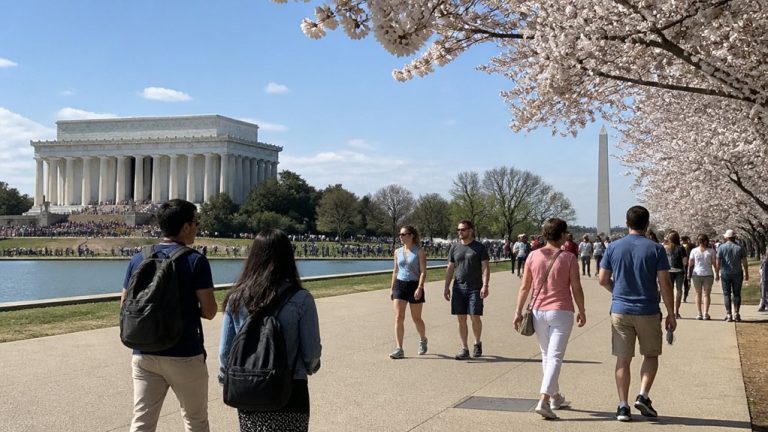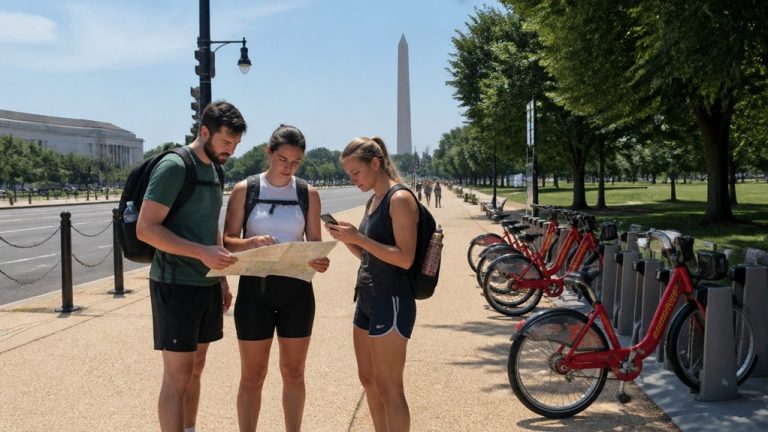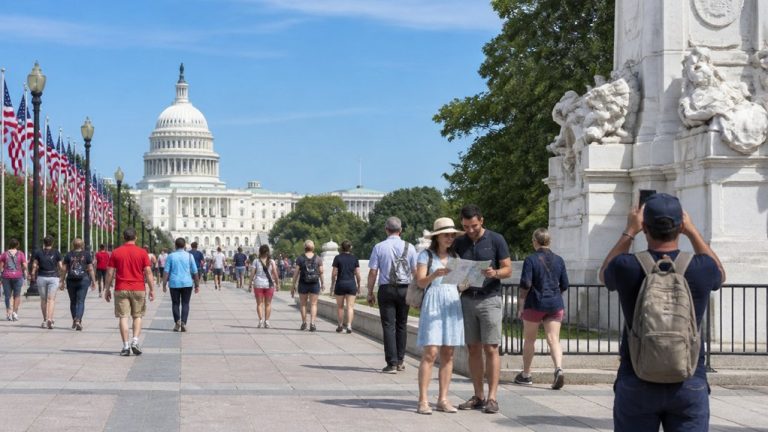

More than 24 million people visit the National Mall each year, yet you can still catch quiet moments if you start early. You’ll cover about 3 miles on the main loop, with cool stone underfoot, flags snapping near World War II, and that long Reflecting Pool view pulling you west. Add one smart museum stop, pack water, and wear shoes you trust. The trick is knowing where to begin, and what not to cram in.
Key Takeaways
- Start early at the Washington Monument Lodge or Smithsonian Metro to enjoy cooler air, easier navigation, and lighter crowds.
- Allow 3–4 hours for the main 3-mile memorial loop, or a full day if adding two or three museums.
- First-timers should prioritize Lincoln, World War II, Vietnam Veterans, and Jefferson Memorial for the classic National Mall experience.
- Choose one or two Smithsonian museums, such as American History, Natural History, or Air and Space, to avoid rushing.
- Spring brings cherry blossoms and huge crowds, fall offers the best balance, while summer requires heat planning and winter is quietest.
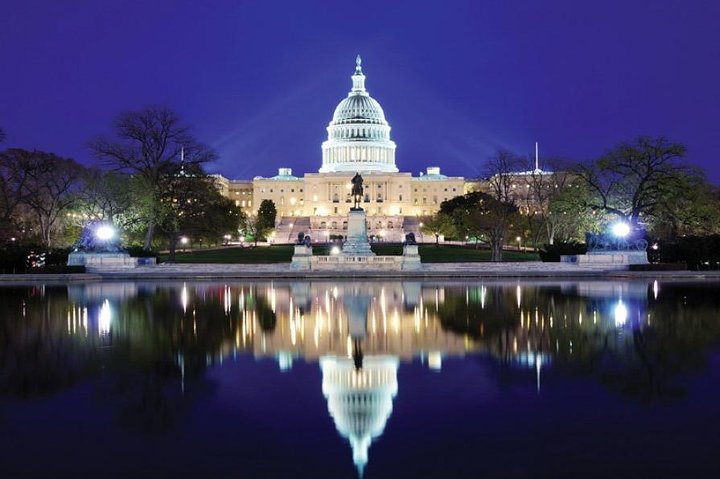
DC Monuments Night Tour with 10+ Stops, National Mall, Tickets
Experience Washington DC lit up at night during this 3-Hour Guided Night Tour of the National Mall and Monuments. Make your way through the city at ni...

DC Night Tour: 10+ National Mall Monuments, Entry Ticket Upgrades
Experience Washington DC lit up at night during this 3-Hour Washington DC Guided Moonlit Tour of the National Mall a...

Washington DC: Easy Sightseeing Guided Monuments Tour by E-Cart
Explore Washington, DC’s iconic monuments and memorials on a relaxed, open-air electric cart tour. Enjoy a small-g...

Washington DC Night Tour: ICONIC Landmarks, Monuments SMALL GROUP
Experience Washington DC at its most striking; after dark! This guided night tour showcases the city’s most iconic...
When Is the Best Time to Visit?

When should you go to the National Mall? For many travelers, spring fall mark the best time to visit. In fall, from September through November, you get cooler air, lighter crowds, and trees glowing red and gold. In spring, especially from mid March through April, the cherry blossom season turns the Tidal Basin into a soft pink cloud. It’s gorgeous, but it also draws about 1.5 million visitors during the festival peak. Summer brings heat, humidity, and the biggest crowds, so you’ll want early starts, sunscreen, water, and shade breaks. Winter feels quieter and cheaper, with fewer visitors and lower hotel rates, though cold winds, snow, and silent fountains can make the National Mall feel a little stern. Aim for main operating hours each day. The park is open 24 hours a day, and early morning visits can be especially beautiful and tranquil.
How Much Time Do You Need?
How long should you set aside for the National Mall? For a visit, give yourself at least 3 to 4 hours to walk the 3 mile loop and see the major memorials. If you want a few museums too, plan on 5 to 6 hours, since the Smithsonian buildings are huge and easy to linger in. A full day, about 7 to 9 hours, works best if you hope to visit two or three museums plus stops. Add 1 to 2 extra hours for the Washington Monument interior, because timed tickets, lines, and the elevator ride take time. Want a slower pace with the Tidal Basin and Jefferson Memorial? Set aside 4 to 6 hours, bring water, and expect plenty of footsteps and pauses. The area is often called America’s Front Yard and includes more than 100 unique monuments and memorials, so extra time can make your visit feel far less rushed.
Where Should You Start the Tour?
Where you begin shapes the whole feel of your National Mall visit, and for most first-timers the smartest starting point is the Washington Monument Lodge on 15th Street NW. Arrive around 7:00-9:00 AM for cooler air, lighter crowds, and easier parking or Metro access. The lodge is a practical self-guided tour trailhead, and the Washington Monument ticket window opens at 8:45 AM. If you want to ride up, reserve free timed-entry tickets ahead of time since visits run 9:00 AM to 5:00 PM. The 555-foot obelisk was built to honor George Washington, the first president of the United States. If you’re chasing cherry blossoms or a shorter outing, start at the Jefferson Memorial instead. You’ll step straight onto the Tidal Basin loop and into soft water views, birdsong, and those famous trees showing off for your camera before the city fully wakes.
What’s the Best National Mall Route?
You’ll get the smoothest first pass by starting at the Washington Monument Lodge on 15th Street NW and following the counterclockwise loop, a roughly 3-mile route that packs in 15 stops, 20 audio points, and a strong finish at the World War II Memorial. If you’ve got half a day, give yourself 3 to 4 miles with rest breaks, aim for 7:00 AM to 4:30 PM, and grab a timed-entry ticket ahead of time if you want to go up the Washington Monument. Short on time? You can swing clockwise toward the Tidal Basin for a 1.7-mile detour to the Jefferson and FDR Memorials, where spring cherry blossoms make the air feel almost staged. To visit the top, reserve timed-entry ticket access in advance since Washington Monument entry is managed by scheduled tickets.

Washington DC Monuments and Memorials Night Tour
See Washington, DC in ways large bus tours can’t—especially after dark. This small‑group night tour (12 guests...

VIP Best of DC with US Capitol + National Archives Reserved Entry
Get the presidential treatment with the most comprehensive Washington DC day tour! The tour includes reserved access...

Washington DC Monuments &Landmark Guided Small Group Trolley Tour
This tour is a great alternative to see DC's Monuments by a stylish American Cart and knowledgeable guide. This tour...
Best Loop Direction
Kick things off at the Washington Monument on 15th St NW, then follow a counterclockwise loop toward the World War II Memorial if you want the simplest first-timer route. It keeps your National Mall bearings easy and your photo stops orderly.
| Direction | Why it works |
|---|---|
| Counterclockwise | Simple, compact, classic first lap |
| Clockwise | Better for Tidal Basin and Jefferson Memorial views |
If you’re arriving by Metro, use Smithsonian station so you can start or finish centrally. Choose clockwise when cherry blossoms brighten the water and you want that long Washington-to-Jefferson stretch early. Choose either direction for an evening visit, since ending near Lincoln and Vietnam feels memorable, glowing, and surprisingly peaceful. This route also fits nicely into one day of exploring Washington, DC. You’ll cover three miles and fifteen stops without doubling back or muttering at map.
Route Timing Tips
Once you’ve picked the counterclockwise loop, timing makes the whole National Mall feel easier and far less crowded. Start at the Washington Monument Lodge on 15th Street NW between 7:00 and 9:00 AM, when the grass is still cool and tour groups haven’t arrived. Give yourself a half day, about three to four hours, to cover the 3-mile route with breaks. If you’re riding up the Washington Monument, reserve the free timed ticket first so it doesn’t hijack your schedule. Hit open sites early, then slide toward the National Museum of American History before afternoon lines build. Want more water views and a longer, quieter stretch? Add the Tidal Basin loop. An e-bike helps, but your feet still deserve restroom stops and a snack. For many first-time visitors, the National Mall is one of the most essential Washington DC experiences, so an early start helps you enjoy its biggest landmarks at their best.
Which Memorials Should You Prioritize?
If your time is limited, start with the memorials that give you the strongest sense of the Mall’s scale and story. Begin at the Lincoln Memorial, where the seated statue, 36 Doric columns, and long view over the Reflecting Pool frame Washington in one sweep. At the Lincoln Memorial, the inscription honors Lincoln as the man who saved the Union and enshrines his memory forever.
Next, walk to Vietnam Veterans and trace the black granite wall of more than 58,000 names. The kiosk helps if you’re searching for someone specific. Then stop at the World War II Memorial for fountains, a broad pool, and 56 pillars for states and territories. Make time for Martin Luther King and the Stone of Hope with 14 etched quotations. If you still have energy, the Franklin Delano Roosevelt Memorial rewards you with outdoor rooms, cool water sounds, and each of FDR’s four terms brought vividly to life.
Which Museums Should First-Timers Visit?
You can’t see everything on your first trip, so start with crowd-pleasers like the National Museum of Natural History, where the Hope Diamond flashes under the lights and family-friendly halls make it easy to keep moving. The museum is especially famous for the Hope Diamond, one of its biggest draws for first-time visitors. If you want history with big-name artifacts, head to the National Museum of American History, or choose the National Air and Space Museum for historic aircraft, spacecraft, and galleries that pull you straight into flight and astronomy. When you want a smart time-saving mix, add the National Museum of the American Indian for living traditions and Native innovation, then finish with the National Gallery of Art and Sculpture Garden if you’re craving a little quiet, color, and a bench between museum marathons.
Best Starter Museums
For most first-timers, the easiest winning lineup starts with the National Museum of Natural History, where you can stand inches from the Hope Diamond and then drift through halls filled with fossils, ocean life, rocks, and human stories. On the National Mall, that central stop helps you get your bearings fast. Next, head to the National Museum of American History for the Star-Spangled Banner and Dorothy’s ruby slippers. It’s also a great place to explore American history through exhibits that trace the nation’s political, cultural, scientific, and social development. Then keep the momentum going at Air and Space, where flight, rockets, and hands-on displays usually win over kids and grown-ups alike. If you’ve got time, add the National Museum of the American Indian for smart, eye-opening exhibits. Round things out with the National Gallery of Art, a calm reset between busy museums and monuments nearby.

Washington DC Monuments Tour by Electric Cart – Day & Night
Experience a whole different side of Washington, DC during our Monuments tour! Climb into our all-electric Red Roads...

Skip-the-Line Washington Monument Tickets + Self Guided Book
Enjoy timed entry access to the Washington Monument observation deck & take in breathtaking 360-degree views of Wash...

Arlington Cemetery Small-Group Tour & Changing of the Guards
Witness the solemn Changing of the Guard ceremony from a prime viewing spot on this guided walking tour of Arlington...
Art Or History
Whether your Mall day leans toward paintings or presidents, the best first stop depends on what makes you slow down and stare.
If you want beauty, start at the National Gallery of Art on the National Mall. Its West Building gives you glowing European and American masterpieces, while the East Building turns sharper and modern. The West Building is especially appealing for first-timers who want a clear, elegant introduction to the museum’s most famous works. Add the Hirshhorn if bold sculpture and rotating contemporary shows sound like your kind of afternoon.
If you want stories, choose the Museum of American History or the Smithsonian National Air and Space Museum. One puts Dorothy’s ruby slippers and the Star-Spangled Banner in front of you. The other surrounds you with aircraft, spacecraft, and big skyward ambition. For deeper roots, the American Indian museum adds Indigenous knowledge too.
Time-Smart Museum Picks
Often, the smartest first Mall museums are the ones that give you the widest view in the least time. On the National Mall, start with the National Museum of American History or the National Museum of Natural History, then add the National Air and Space Museum if rockets call your name. The Air and Space Museum guide is especially helpful for finding exhibit highlights before you go.
| Museum | Best for | Time |
|---|---|---|
| American History | Star-Spangled Banner, ruby slippers | 60–90 min |
| Natural History | Hope Diamond, butterflies | 60–90 min |
| Air and Space | Planes, capsules, check hours | 60–90 min |
Go from 9:00 AM to 4:30 PM, book timed entry when needed, and keep your pace focused. If you have extra time, sample Indigenous insight or a quick art contrast nearby before dinner and sunset photos.
How Do You Get Around the Mall?
Start with your feet, because the easiest way to take in the National Mall is to walk its main loop, which usually runs about 3 miles, or closer to 4 if you wander down extra paths and memorial spurs. For exploring the National Mall, you’ll get the best feel for the monuments and memorials at sidewalk speed, with room to pause and look around. Metro access makes arrival too. Ride to Smithsonian station and skip pricey parking. If you want to cover ground faster, rent an e-bike or scooter and follow rules. Yield to walkers. Use bike lanes when you see them. Keep a map handy, check Google Maps, and ask Park Rangers for help. They’re on duty daily, and they know every turn. Before you head out, check System Status and next arrivals so you can avoid delays and time your trip smoothly.
What Should You Pack and Know Before You Go?

Before you head out, pack like you’re planning for a long, bright walk with a few weather surprises.
Wear supportive shoes because your typical National Mall loop can top almost three miles, and your feet will notice. Bring a refillable water bottle, sunscreen, sunglasses, a hat, and layers for Washington DC mood swings. Toss a charged phone, power bank, and earbuds into a small day bag with sanitizer, tissues, bandages, and a poncho or umbrella. Add a blanket if you want grass seats. Download a self-guided audio tour before you go. If you plan to Visit the National Monument, reserve free timed-entry tickets through the National Park Service site. Budget for food trucks or nearby restaurants since on-Mall choices stay pretty slim by lunchtime. For first-time visitors, Washington DC weather can shift quickly between sun, wind, and sudden rain, so checking the forecast before you leave is a smart move.
Frequently Asked Questions
Are There Good Food Options Near the National Mall?
Yes, you’ll find plenty: Food trucks line areas, Museum cafeterias offer quick meals, Nearby restaurants serve varied cuisines, and Picnic spots let you relax with takeout. You can eat well without leaving the National Mall.
Where Can You Find Restrooms Along the National Mall?
Like breadcrumbs, you’ll find Public restrooms in museums and memorials and visitor centers; Portable toilets dot busy stretches. Check maps for Restroom locations and use Accessible facilities at major sites—you won’t have to wander far.
Is the National Mall Safe to Visit at Night?
Yes, you can visit the National Mall at night if you stay alert. For night safety, follow lighting tips, use late transport, and take solo precautions; you’ll feel safer near lit monuments and busier paths.
Can You Take Guided Tours of the Memorials and Monuments?
Like opening a history book, you can take ranger led tours, book private tour companies, use self guided apps, or choose accessible guided tours, so you’ll explore memorials and monuments in whatever way suits you.
Are Pets Allowed on the National Mall Grounds?
Yes, you can bring leashed pets onto most National Mall grounds, but you must clean up pet waste. You should check seasonal restrictions, and remember service animals are allowed anywhere visitors may go freely.
Conclusion
By the end, you’ll test a common theory: the National Mall looks easy on a map and much bigger in the sun. It’s true. Your shoes will feel the gravel, fountains will hiss, and the Lincoln Memorial steps will seem to rise forever. Start early, choose a route, and give yourself room to linger. If you plan well, you won’t just see Washington. You’ll hear it, pace by pace, with a water bottle in hand.
DC Monuments Night Tour with 10+ Stops, National Mall, Tickets
Experience Washington DC lit up at night during this 3-Hour Guided Night Tour of the National Mall and Monuments. Make your way through the city at ni...

Washington DC Sightseeing Tour with Vintage Model-T Classic Cars
Experience the enchanting beauty of Washington, D.C.'s monuments and landmarks on a captivating day and night tour a...

Mount Vernon and Old Town Alexandria Day Trip from Washington DC
Learn about the life of George Washington, first president of the United States, on this guided tour of Mount Vernon...

US Capitol, Supreme Court or Library of Congress Small-Group Tour
Do you want to learn about the iconic buildings of Capitol Hill and their complex history? Do you want a guide that...